CHARM is a hub of interdisciplinary integration and infrastructure development to drive cross-cutting materials innovation. Using its materials science platform at the University of Delaware, CHARM is committed to training a new generation of innovators with focused K-12 and Undergraduate education programming.
OUR MISSION
Create a world-recognized hub of interdisciplinary integration and infrastructure development to drive cross-cutting materials innovation.
OUR VISION
Harness the integrated power of computational design, innovative synthetic and manufacturing processes, and nano-scale characterization to unlock the substantial promise of complex, synthetic materials at multiple length/time-scales.
 Brochure
Peptide Active Materials (PAMs)
Motivation and Impact
Harnessing the immense polyaminoacid complexity of nature and beyond without billions of years of evolution
Nature Inspired Materials
MOTIVATION:
Life is possible due to proteins: polyaminoacid macromolecules with exquisite folded nanostructure producing specific function that is encoded in the amino acid sequence.
KEY CHALLENGE:
Restricted toolbox of natural or mutated protein structures limits design of non-natural materials.
VISION:
Computational design to realize synthetic peptides that fold and assemble into rigid, protein-like building blocks to produce designed Nanostructure (Aim 1), Motion (Aim 2), and Simple Machines (Aim 3).
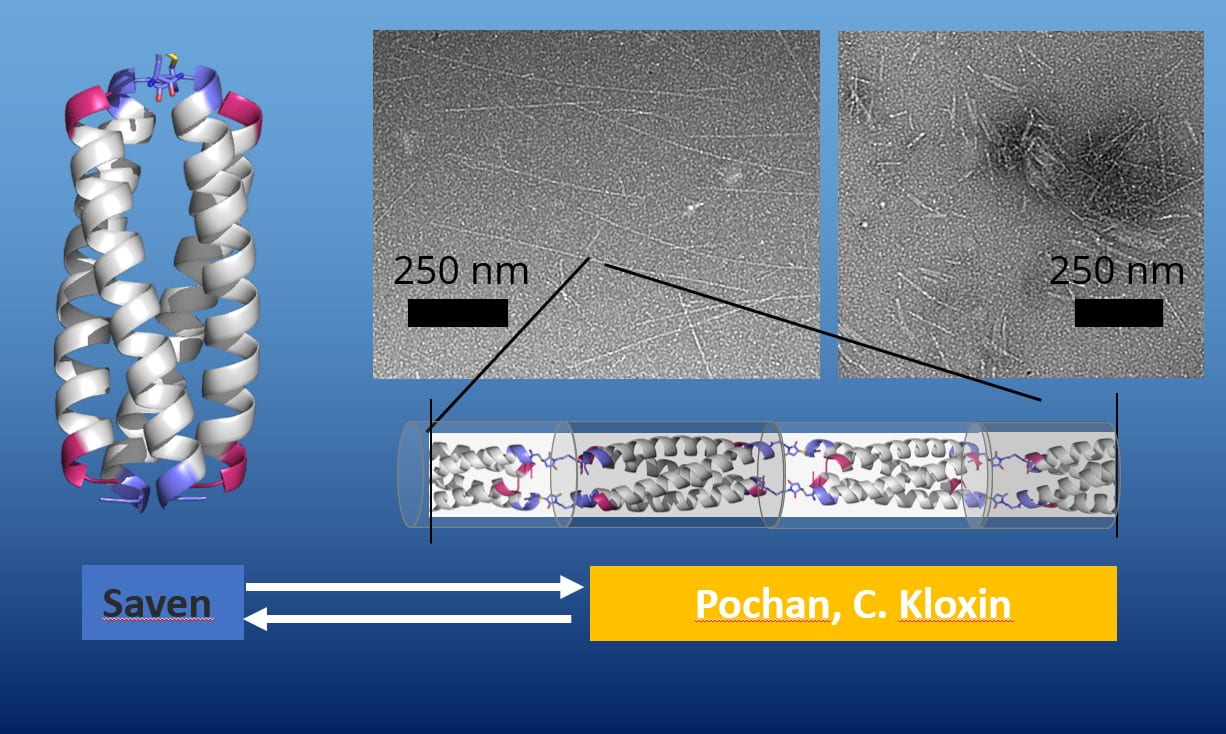
Saven, C. Kloxin, Pochan, and coworkers, “Polymers with controlled assembly and rigidity made with click-functional peptide bundles,” Nature 574 (2019): 658-662


Hybrid Quantum Materials with Emergent Terahertz Functionalities (HQ-METs)
Motivation and Impact
Terahertz (THz) electromagnetic radiation could be a powerful tool for applications like biomedical and security screening. However, THz technologies significantly lag those in other wavelength ranges (i.e. Radio Frequency, visible, or near-infrared photonics). This is fundamentally a materials challenge: there is no single material platform that is simultaneously a good source, waveguide, and detector for THz excitations.
KEY CHALLENGE:
Material platforms tend to be well-suited for one THz functionality (e.g. sources, waveguides, or detectors) and poorly suited for others.
VISION:
Understanding and controlling the integration of different material classes allows transduction of THz frequency excitations across the interfaces (Aim 1), control of emergent THz functionality (Aim 2), and creation of hybridized states with fundamentally new properties (Aim 3).
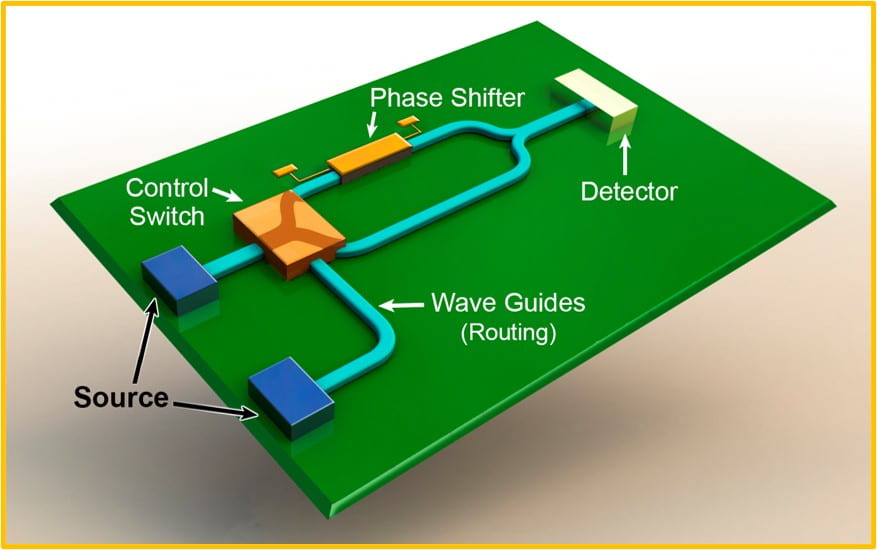
THz frequency photonic integrated circuits would enable new technologies but are hampered by limitations in crucial components and integration challenges.