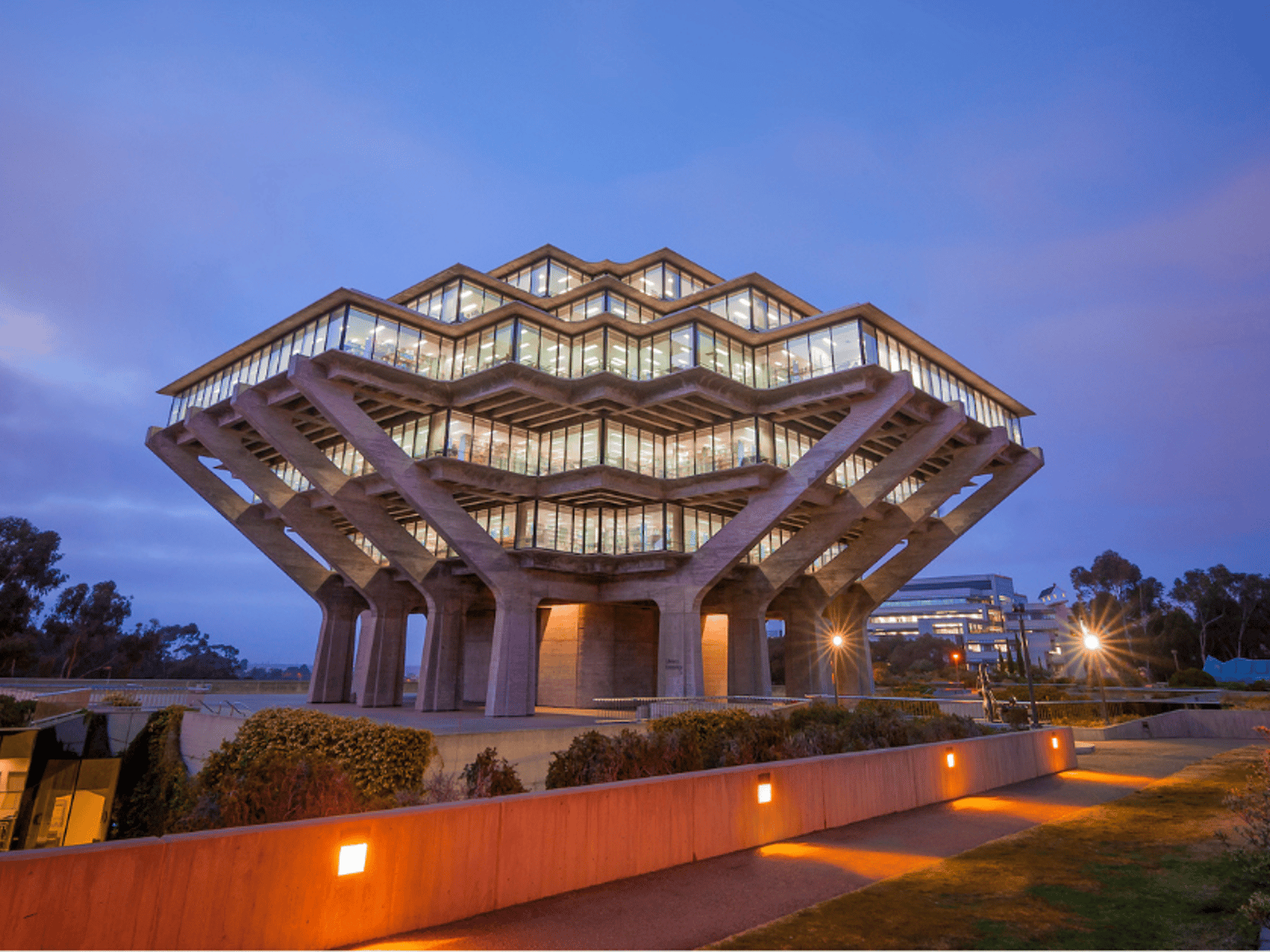
The Materials Research Science and Engineering Center at the University of California-San Diego (UCSD MRSEC) serves as a center of excellence that unites innovative, interdisciplinary teams of scientists and engineers to tackle complex, fundamental problems in materials science. Research efforts are conducted within two interdisciplinary research groups. The first group transcends the boundaries of conventional optics by creating a novel class of materials known as quantum metamaterials. Modern technology is typically limited by the natural properties of materials found on Earth. This group uses custom-designed quantum building blocks to make artificial structures that can manipulate light at unprecedented speeds and intensities, paving the way for next-generation computing, communication, and optoelectronic technologies. The second group is harnessing the power of synthetic chemistry to design a new class of electronic materials that are only a few atoms thick. They create highly organized molecular patterns that control how electrons move and interact with one another. Using computer modeling in concert with chemical synthesis, this team designs a new paradigm for the development of ultra-efficient electronic and quantum technologies. Both groups are targeting fundamental breakthroughs that impact national priority areas, including quantum computing, quantum sensing, and quantum information technologies. Empowering this research is an integrated training activity that enhances national proficiencies in the science, technology, engineering, and mathematics fields and cultivates a highly skilled technical workforce through hands-on research opportunities. A partnership with the Fleet Science Center connects the UCSD MRSEC with the wider San Diego community to demonstrate the everyday impact of materials research.
IRG 1
IRG 1 uses quantum clusters, particles, and quantum wells as the building blocks for quantum metamaterials that harness quantum confinement, correlations, and ultimately entanglement as new levers of optical functionality, to achieve ultrahigh nonlinearities and ultrafast response speed.
IRG 2
IRG 2 deploys synthetic organic and coordination chemistry to design electronic states in two-dimensional superlattices, assembling molecules onto, or superimposing molecular lattices over, a parent low-dimensional solid-state material, and focuses on realizing collective phenomena such as superconductivity and quantum spin liquids.