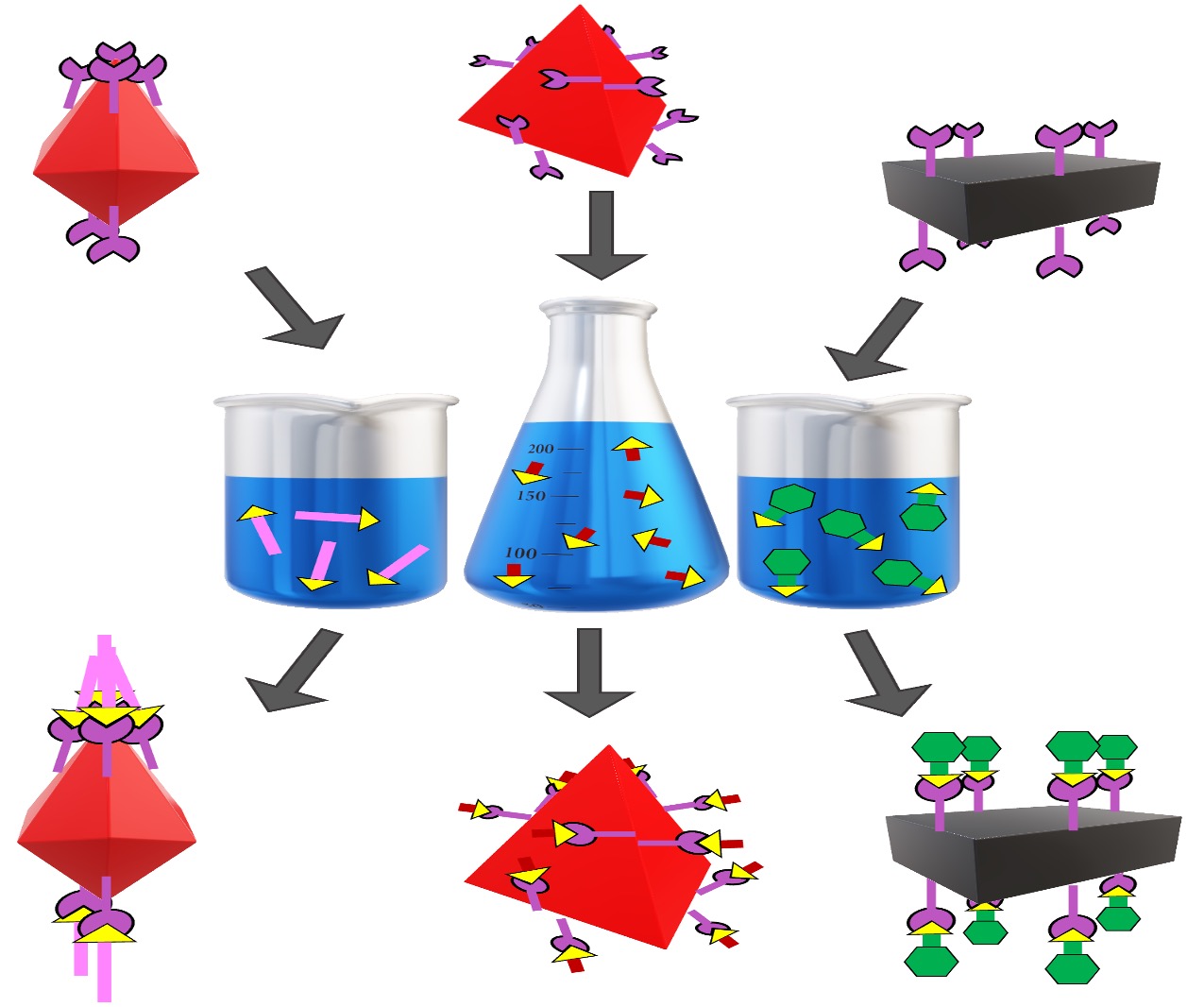
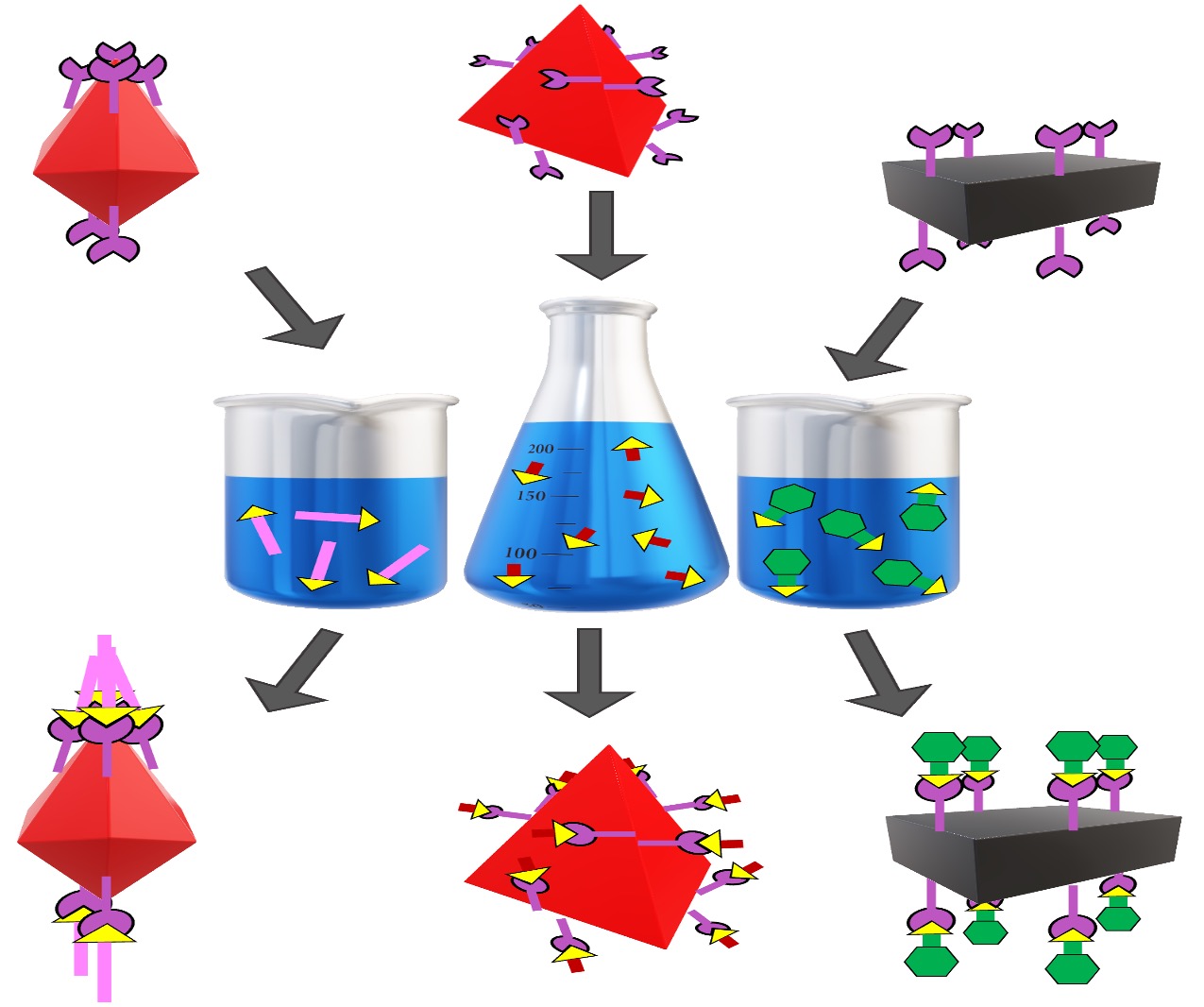
 Straightforward and rapid modification techniques allow for the use of porous coordination cages in network solids, flexible adsorbents, and stimuli-responsive, peptide-based materials.
Porous coordination cages represent simple molecular versions of complex solid-state materials. While tunable, their modification remains challenging. This work details a new toolkit for the rapid modification of these cages.
- We have shown, for the first time, that click chemistry can be used to functionalize multiple families of porous cages.
- Incorporation of certain functional groups onto porous cages has been challenging, this approach can be used to dramatically expand the chemistry of porous cages.
- Utilization of porous cages as building blocks in peptide-based materials (IRG 1) was contingent on the development of modification techniques for the cages.
- With this toolkit in hand, work toward the development of higher-dimensional peptide bundlemers is progressing rapidly.
 Download
Center for Hybrid, Active, and Responsive Materials (2020)
UD CHARM advances foundational understanding of new materials driven by theoretical and computational predictions paired with cutting-edge experiments to enable the integration of unconventional, ultra-small, building blocks.