UMass Amherst Materials Research Science and Engineering Center (2008)
The UMass MRSEC mission
Materials research at UMass Amherst has a rich history of fundamental discovery centered in polymers and extending across the landscape of colloidal materials, surface science, and nanoscale structures. NSF support for the UMass MRSEC has been instrumental in landmark findings in polymer crystallization, block copolymer assembly for high density addressable media, ultrathin free-standing nanoscale structures, and state-of-the-art advances in polymer adhesion and self-healing. Our materials research mission merges with vibrant programs designed to educate students towards rewarding careers in science and technology. This is manifest in teaching and mentoring, where UMass Amherst is a national leader in graduate education in polymers and soft materials chemistry, physics, and engineering. Our educational mission extends to all ages and grade levels, thanks to a rich diversity of Center-supported programs designed for undergraduates, teachers, and grade school children alike. Today the UMass MRSEC seeks to define the future of polymer materials science and engineering, with research teams engaged in innovative multidisciplinary projects that push fundamental boundaries and create new technologies.
University of Houston MRSEC on Advanced Oxides and Related Materials (1996)
The Materials Research Science and Engineering Center (MRSEC) at the University of Houston supports research on the synthesis and characterization of oxide materials that have technologically important applications in ionic devices in one interdisciplinary research group. The devices include membrane and electrocatalytic reactors, solid oxide fuel cells, and chemical sensors. The devices promise major advances in industrial chemical processes by improving product selectivity, process efficiency and environmental compatibility. Special emphasis is on complex oxides that are active catalysts for hydrocarbon oxidation and oxygen reduction and have the high ionic conductivity and electronic conductivity required for ionic devices. The MRSEC supports the development, operation and maintenance of shared experimental facilities for materials research. It provides seed funding for exploratory research, fosters research participation by undergraduates and pre-college students, and is developing strong industrial relationships. The Center currently supports 11 senior investigators, 3 postdoctoral research associates, 10 graduate students, and 6 undergraduates. The MRSEC is directed by Professor Paul C.W. Chu. %%% Changing needs in transportation fuels, increasing availability of natural gas, and the emphasis on energy efficient, environmentally benign processes are driving new demands for advanced catalytic and ceramic materials. These trends suggest new opportunities for improved catalytic and separation processes that apply novel oxide materials in new energy production approaches. The Materials Research Science and Engineering Center (MRSEC) at the University of Houston supports research on the synthesis and characterization of oxide materials that have technologically important applications. The MRSEC supports the development, operation and maintenance of shared experimental facilities for materials research. It provides seed funding for explora tory research, fosters research participation by undergraduates and pre-college students, and is developing strong industrial relationships. The Center currently supports 11 senior investigators, 3 postdoctoral research associates, 10 graduate students, and 6 undergraduates. The MRSEC is directed by Professor Paul C.W. Chu.
CPIMA — Center on Polymer Interfaces and Macromolecular Assemblies (2002)
The Center on Polymer Interfaces and Macromolecular Assemblies (CPIMA) is an NSF sponsored partnership among Stanford University, IBM Almaden Research Center, the University of California Davis and the University of California Berkeley. CPIMA is dedicated to fundamental research on interfaces found in systems containing polymers and low molecular weight amphiphiles.
Single Crystal Study of Electronic Topology and Correlation
Joe Checkelsky, Assistant Professor, Department of Physics
A relatively unexplored parameter in topological insulators is electronic correlation. Motivated by the metal-insulator transition observed in the pyrochlore iridates R2Ir2O7 (R is a rare earth) it has been suggested that a combination of weak to moderate correlation effects and large spin-orbit interaction may exist that could give rise to new topologically non-trivial electronic states. In particular, it is expected that this compound’s principle bulk excitations may be described by a 3-dimensional analog of graphene known as a Weyl semimetal with helical excitations in all 3 dimensions with a several exotic and potentially useful properties. Despite these sharp theoretical predictions, the experimental situation is unsettled owing largely to the difficulty in producing single crystal specimens. While optical furnace techniques used for other pyrochlores have thus far proven unsuccessful in producing single crystals, we propose to extend a flux technique reported for R=Eu and Pr across this series to develop high quality single crystals and perform incisive studies of the magnetic transition and transport properties of the electronic ground state. If successful, this study would open the door for other optical and scattering experiments as well as extensions to Os oxides and spinel candidate compounds.
Seed 2: Room Temperature Spin-orbit Torque Switching Induced by a Topological Insulator
Research Summary: Recent studies on magneto-transport properties of topological insulators
(TIs) have attracted great attention due to the rich spin-orbit physics and promising applications
in spintronic devices. Particularly, the strongly spin-momentum coupled electronic states have
been extensively pursued to realize efficient spin-orbit torque (SOT) switching (Figure 1(a)).
However, so far current-induced magnetic switching with TIs has only been observed at
cryogenic temperatures. The goal of this seed project is to understand whether the topologically
protected electronic states in TIs could benefit spintronic applications at room temperature.
In this seed project, full SOT switching has been demonstrated in a TI/ferromagnet
heterostructure with perpendicular magnetic anisotropy (PMA) at room temperature (Figure
1(b)) [1]. Ferrimagnetic cobalt-terbium (CoTb) alloy with bulk PMA was used to overcome the
effects of the interfacial lattice mismatch, permitting direct growth on the classical TI material
Bi2Se3. The low switching current density (~ 3 × 10⁶ A/cm2) provides definitive proof of the high
SOT efficiency from the TI. The SOT efficiency was measured by the current-induced shift of
the Hall resistance-versus-magnetic field hysteresis loops (Figure 1(c)), which is consistent with
the model of the current-induced Néel-type domain wall motion. Accordingly, the effective spin
Hall angle of the TI was determined to be several times larger than in commonly used heavy
metals (Figure 1(c)). Moreover, power consumption for switching a ferromagnetic layer with
either a TI or a heavy metal was calculated, indicating that magnetization switching with TIs
presents much higher energy efficiency than with conventional heavy metals. These results
demonstrate the robustness of TIs as an SOT switching material and provide an avenue
towards applicable TI-based spintronic devices.
Rearrangements & Softness in Disordered Solids
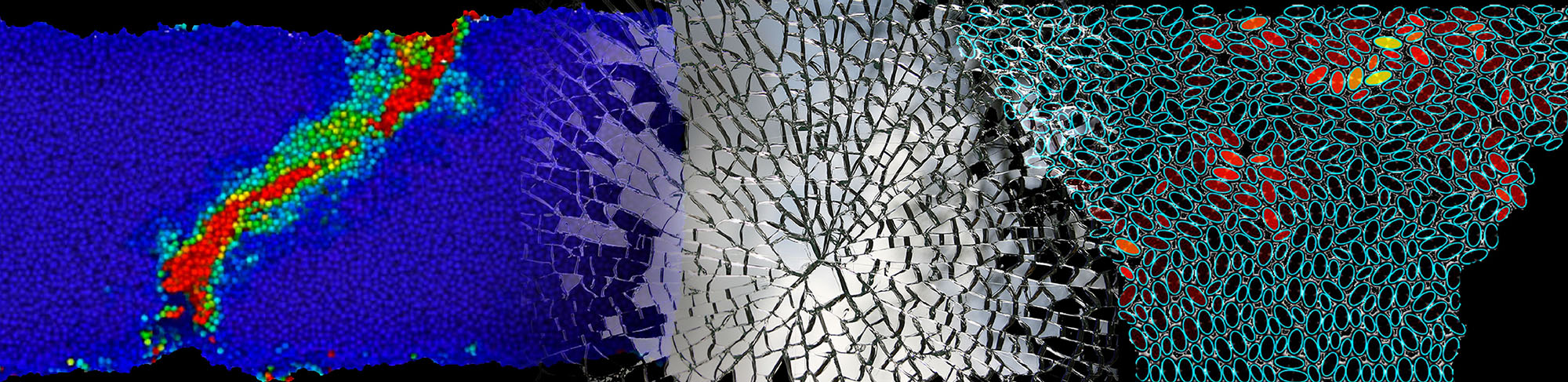
Rearrangements & Softness in Disordered Solids aims to develop fundamental understanding of the organization and proliferation of localized particle-scale rearrangements in disordered solids deformed just beyond the onset of yield, and thereby identify strategies for controlling nonlinear mechanical response and enhancing toughness. The materials studied by the team span a wide range of length scales from amorphous carbon and atomic/molecular glasses, to nanoparticles and colloids, to macroscopic bubbles and grains. When pushed beyond yield, some materials crack or shatter due to rearrangements that collect along planes, whereas others flow smoothly because rearrangement events remain separated. New theoretical concepts, some based on machine learning, will be developed to understand this dramatic difference, and these theories will be tested by atomistic simulations and experiments on systems for which it is possible to measure microstructure versus time during a large imposed deformation. Ultimately, these factors will be optimized to widen the window between yield and failure and hence to improve toughness.
Materials Research Science and Engineering Center at UCSB (2017)
The Materials Research Science and Engineering Center at the University of California, Santa Barbara will carry out research within three Interdisciplinary Research Groups or IRGs. The three IRGs address fundamental problems in materials research that could not be advanced without contributions from a team of interdisciplinary and collaborative domain experts. The research in every IRG integrates synthesis, theory/computation, and characterization/property measurement to advance fundamental understanding and develop promising materials classes for a range of applications. The scientific challenge for IRG-1 is to understand and develop unprecedented control over the couplings between strain, magnetization, and temperature in single- and multiphase intermetallic compounds to advance technologies including actuation and solid-state refrigeration. For IRG-2, the challenge is to develop novel polymeric ionic liquid chemistries, understand self-assembly and ion transport in these materials, and develop applications that incorporate the emergent properties of multi-valent ion conductivity, light-driven adaptive mechanics, switchable redox activity, and magnetic response. Inspired by natural marine materials, IRG-3 aims to discover how material assembly and innovative processing can help establish the foundational design rules for creating versatile, graded, multiphase soft materials for eventual use applications such as advanced fabrics, packaging, additive manufacturing, and tissue replacements, and as self-shaping, self-healing, and reconfigurable materials platforms. Seed Projects will be competitively awarded for two-year periods, and will bring in collaborative investigators who will take the MRSEC in promising new directions. Alongside the research UCSB MRSEC scientists and education staff are dedicated to improving access to science and to building a dynamic and inclusive workforce of scientists and engineers. The portfolio of education programs has a core focus on undergraduate research opportunities. Outreach activities will also involve K-12 students, support of teachers to create relevant curricula, and the broader lay public, to share current excitement in materials research. Initiatives to develop a diverse workforce emphasize graduate students and post-doctoral fellows.
Designing Materials Using Directed Evolution
The goal of this Seed is to develop new materials with unique properties through directed evolution. Through genetic mutation, protein expression, and high throughput materials screening, this Seed is harnessing the power of biological evolution for materials design. Our Seed is developing high throughput protein expression and purification techniques to synthesize sufficient quantities of material for characterization of mechanical and interfacial properties. Parallel efforts are exploring high-throughput screening methods to identify successful mutants within a large genetic library. Our work is developing new materials and understanding how existing biomaterials may have been developed through eons of evolution.
Center for Emergent Materials (2008)
The Materials Research Science and Engineering Center (MRSEC) at the Ohio State University (OSU), titled Center for Emergent Materials (CEM), performs integrated research on emergent materials and phenomena in magnetoelectronics. The aim of the Center research activities is to advance understanding of the emergent materials and phenomena and to develop highly sophisticated experimental and theoretical tools required to study them, which will lay down the scientific foundation for building future oxide-based electronic devices that can perform multiple functions, and energy-efficient, fast computers that have integrated memory and logic. The Center has two interdisciplinary research groups (IRGs). IRG 1, Towards Spin-Preserving, Heterogeneous Spin Networks, will develop a new understanding of electron-spin injection and transport in low-dimensional, spin-preserving materials such as silicon and carbon. This understanding provides a new materials basis for creating novel high-density spin networks for next-generation computing. IRG 2, Double Perovskite Interfaces and Heterostructures, designs and controls multifunctional properties of innovative double perovskite heterostructures through the understanding of structure, defects, and magnetotransport properties at interfaces. This new knowledge of magnetism in metallic oxides enables important advances in the emerging field of oxide-based electronics. The IRGs are complemented by a Seed Funding program, which provides the necessary flexibility and vitality to CEM in responding swiftly and effectively to the rapidly-changing materials research landscape. Integrated with the research activities, CEM enhances classroom education, creates research internship opportunities, widens the Science-Technology-Engineering-Math (STEM) "pipeline," and enhances diversity in STEM. Activities include an innovative education research program aimed at cognition of materials science concepts, K-12 outreach and visitation programs, undergraduate research programs, and graduate-education enhancement programs. The multidisciplinary OSU materials community is already home to major world-class shared experimental facilities, which are brought to bear on CEM research and education. The Center collaborates with the electronics, storage, and instrumentation industries; national laboratories and institutes; other U.S. universities; and international universities and laboratories in China, India, Germany, and United Kingdom.
Synergistic Linear and Nonlinear Phenomena in Multifunctional Oxide Ceramic Systems
IRG #1 seeks to advance fundamental knowledge leading to the development of energy-efficient and novel multifunctional devices for electronic, optoelectronic, storage, sensor and information technologies. The methodologies employed by the group include exploring and exploiting the unique attributes of oxide materials, resulting in two or more functionalities; and developing a thin film platform to integrate multifunctional oxides. The group focuses on oxides which simultaneously exhibit a combination of electrical conductivity, optical transparency, linear and non-linear response to external electrical, magnetic and stress fields. They are also working to validate and optimize coupled phenomena (for example optical transparency with electrical conductivity; ferroelectricity with ferromagnetism). The development of a thin film and heterostructure integration strategy is underway; and first-principles theory and simulation are being coupled with device modeling and characterization
Showing 1091 to 1100 of 2653