SUNY Stony Brook - Thermal Spray (1996)
Herman The Materials Research Science and Engineering Center (MRSEC) at the University of New York at Stony Brook supports research in the area of thermal spray processing and associated materials. Thermal spray coatings are crucial to the economic, safe, and efficient operation of a wide variety of engineering components. The Center has a focus on key scientific issues which are likely to play a role in thermal spray processing. The research is carried out in two interdisciplinary research groups. One group integrates diagnostics and modeling of the plasma spray process in order to develop tools for generating process designs and intelligent control strategies. A second group concentrates on basic understanding of the relationship between processing, microstructure, and properties of the thermal spray product. Details of the microstructures will be linked through modeling to activities in the first group. Special emphasis is placed on measurement of mechanical properties and on application of a variety of sophisticated characterization tools. The MRSEC supports the development, operation and maintenance of shared experimental facilities for materials research. It provides seed funding for exploratory research and emerging areas, and fosters research participation by undergraduates. The MRSEC has strong industrial links and an educational outreach program from the pre-college to the graduate level. The Center currently supports 13 senior investigators, 3 postdoctoral research associates, 1 technician, 8 graduate students, and 4 undergraduates. The MRSEC is directed by Professor Herbert Herman. %%% The Materials Research Science and Engineering Center (MRSEC) at the University of New York at Stony Brook supports research in the area of thermal spray processing and associated materials. Thermal spray coatings are crucial to the economic, safe, and efficient operation of a wide variety of engineering components. The Center has a focus on key scientific issues which are likely to play a role in thermal spray processing. The research is carried out in two interdisciplinary research groups. One group integrates diagnostics and modeling of the plasma spray process in order to develop tools for generating process designs and intelligent control strategies. A second group concentrates on basic understanding of the relationship between processing, microstructure, and properties of the thermal spray product. Details of the microstructures will be linked through modeling to activities in the first group. Special emphasis is placed on measurement of mechanical properties and on application of a variety of sophisticated characterization tools. The MRSEC supports the development, operation and maintenance of shared experimental facilities for materials research. It provides seed funding for exploratory research and emerging areas, and fosters research participation by undergraduates. The MRSEC has strong industrial links and an educational outreach program from the pre-college to the graduate level. The Center currently supports 13 senior investigators, 3 postdoctoral research associates, 1 technician, 8 graduate students, and 4 undergraduates. The MRSEC is directed by Professor Herbert Herman.
Columbia Center for Mixed Organic/Inorganic Materials and Structured Thin Films (1998)
The Materials Research Science and Engineering Center (MRSEC) at Columbia University focuses on organic/inorganic materials, with an emphasis on materials chemistry. The Center also provides seed funding for new opportunities in materials research. The Center supports efforts in materials education at all levels, including summer undergraduate research experiences and research experiences for high school science teachers. The MRSEC also supports shared experimental facilities that are accessible to center participants and to outside users, and has strong research collaborations with other universities and industrial laboratories in the New York City metropolitan area.
Research in the Columbia MRSEC is organized in an interdisciplinary research group that addresses the science of inorganic nanocrystal arrays within polymer or organic media. Participants in the Center currently include 12 senior investigators, 4 postdoctoral associates, 12 graduate students, 16 undergraduates and 1 administrative support personnel. Professor Irving P. Herman directs the MRSEC.
IRG 2: Engineered Living Materials

The intellectual focus of IRG 2: Engineered Living Materials is to develop methods to integrate engineered living matter with polymeric materials. In doing so, we will create new composite materials that are responsive to diverse stimuli and capable of generating complex, genetically encoded material outputs. Our long-term research goals are to develop techniques that will enable the creation of materials at the living/non-living interface, with the potential for use in biosynthetic electronics, chemical threat decontamination, therapeutic synthesis/delivery, and soft robotics, among other applications. To accomplish these goals, we will integrate genetically-modified photosynthetic organisms (e.g., cyanobacteria, plant cells, and algae) with polymeric materials through gel immobilization, patterning on flexible/elastomeric substrates, or deposition onto mechanically robust films. Within these materials, genes will be activated in response to a specific stimulus that will control material properties. Our proposed research goes beyond bio-mimetic or bio-inspired materials; living systems and polymeric materials will be synergized to achieve unprecedented control of material properties and function in the emerging area of engineered living materials. Fundamental challenges inherent to living materials will be pursued in the context of three research thrusts:
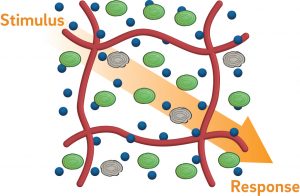
Stimuli-Responsive Biosynthetic Materials. Fabricate biosynthetic composite materials by integrating engineered cells into gels, 3D-printed structures, and elastomers to develop materials that are chemical factories. Current stimuli-responsive materials lack a diversity of inputs and consequently respond with modest material outputs. We will create materials that respond genetically to specific, diverse stimuli—e.g., chemical threat exposure, circadian cycle, and disease states—and produce a range of outputs, including threat deactivation, cyclical thermal insulation, and triggered therapeutic production, respectively.
Photosynthetic Electronic Materials. Pattern and synthesize polymer electronic materials using photosynthetic organisms. Engineered cells offer the ability to perform complex biosynthetic chemistry to form monomers for conducting polymers (e.g., thiophene or pyrrole), as well as oxidative polymerization catalysts (e.g., peroxidases). We will engineer plant cells, cyanobacteria, and algae to synthesize these components in response to light (optogenetics). These cells will be integrated into polymeric substrates by roll-to-roll manufacturing, gel encapsulation, and soft-lithography to yield biocomposite materials that can be photolithographically patterned into electronic circuits.
Auto-Regenerative and Shape-Shifting Materials. A single-step genetically controlled polymerization will be initiated by engineered cells to achieve auto-regeneration of damaged materials and material folding (i.e., polymer origami). Genetically engineered cells that produce olefin monomers and metal-free catalysts for controlled radical polymerization (CRP) will be incorporated into polymeric materials. Once activated, the engineered cells will produce all requisite material for CRP that will produce polymers with diverse mechanical properties. We anticipate using these composites to heal material damage (i.e., auto-regeneration) and to induce complex geometric changes by generating asymmetric forces through differences in mechanical properties.
IRG-2: Bioinspired Active Materials
Charge-matter Interactions in Bioinspired Supramolecular Materials
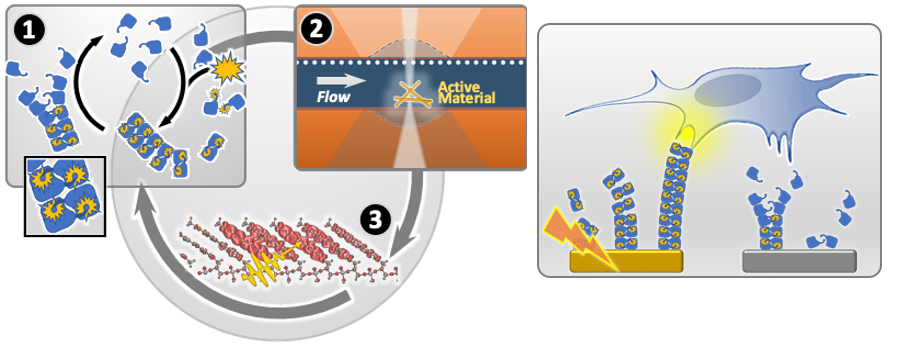
This IRG will develop active conductive supramolecular materials that self-assemble in response to electronic and other stimuli. While a variety of stimuli—including chemical, light, and mechanical triggers—have been used to control synthetic supramolecular polymerization, the interactions between charge and synthetic self-assembled systems are poorly understood. This IRG will support an integrated team effort to investigate actively assembling materials inspired by biological systems to seamlessly interface biology and synthetic electronic devices.
Research objectives will include:
design and synthesis of novel active materials fueled by electrical and other energy,
integrated computational and experimental mechanistic investigations of active self-assembly systems, and
experimental and theoretical characterization of the emergent electronic and mechanical properties of the active supramolecular systems to inform iterative materials design.
Building on this IRG’s strong and complementary expertise in materials design and synthesis, as well as experimental and computational studies, a highly interdisciplinary plan is proposed to gain fundamental understanding of charge-matter interactions in bioinspired supramolecular materials. This research will provide foundational knowledge in Synthetic Materials Biology for how to effectively interface living and nonliving matter for future technological development of artificial intelligence and bioelectronics.
Harvard Materials Research Center (1998)
The Materials Research Science and Engineering Center (MRSEC) at Harvard University supports a broad research program organized through three interdisciplinary research groups, as well as a wide range of educational activities, including project TEACH (The Educational Activities of Cambridge-Harvard) which aims to interest seventh grade students in preparing for college. The MRSEC is supporting the introduction of "peer instruction" in area public schools and supports a nationally advertised Research Experience for Undergraduates (REU) program. The Center supports well maintained shared experimental facilities which are accessible to outside users and also supports interactive efforts with industry and other sectors.
One of the three interdisciplinary research groups is investigating artificially structured materials and electronic microsystems. This group supports work on atomic surface transport, nanowires, soft lithography, and atom lithography. The goal of some of this work is the fabrication of small structures without the use of visible light projection and patterning. A second group is exploring the interfaces between synthetic and biological systems with opportunities in sensors, biocompatible devices, and tools for molecular and cell biology research. The third group investigates thermo-mechanical properties at small length scales of diverse systems such as carbon nanotubes, multi-layer metal-semiconductor assemblies, and novel microsystems made with soft lithography.
Wisconsin Materials Research Science and Engineering Center (2017)
The Wisconsin MRSEC brings together teams of researchers - undergraduates, graduate students, postdoctoral fellows and faculty - from diverse disciplinary backgrounds from across the University of Wisconsin-Madison and other key partner universities to understand at the level of atoms and molecules how to create new materials that will enable next-generation technologies. By addressing fundamental challenges related to a critical void in knowledge involving disorder in materials, and the emergence of order from disordered materials, new materials for telecommunications, clean energy, quantum information sciences and biotechnologies are being developed. The Center integrates the discovery and sharing of new knowledge with national leadership in development and dissemination of research-inspired educational materials for K-12 and the public, innovative projects that broaden participation of groups underrepresented in STEM fields, development of new characterization facilities that integrate data analysis and sharing, industry outreach to promote regional economic development, and professional development and international opportunities that train the next-generation US workforce.
University of Wisconsin-Madison MRSEC on Nanostructured Interfaces (2005)
The Materials Research Science and Engineering Center (MRSEC) at the University of Wisconsin addresses the science and engineering of nanostructured interfaces. The MRSEC plays a critical role in promoting collaboration between a wide variety of scientific and engineering disciplines at which the University of Wisconsin excels. It includes a leading-edge, world-renowned interdisciplinary education group. The Wisconsin MRSEC has the philosophy that Education and Human Resource Development requires the same level of innovation as research. This philosophy provides a wealth of opportunities to bring the excitement of cutting-edge MRSEC research to diverse audiences. The UW-Madison MRSEC's Interdisciplinary Education Group (IEG) is a national leader in producing new instructional aids illustrating nanoscale materials and phenomena in MRSEC-related topics, and in materials science and engineering more broadly. The MRSEC supported shared experimental facilities provides infrastructure to the broader materials science community on campus and regionally.
The University of Wisconsin's MRSEC is comprised of three Interdisciplinary Research Groups (IRGs): IRG-1: Silicon Based Nanomembrane Materials will explore the science and technology of membranes so thin that the thinness determines the structure and topography, and creates unique electronic, mechanical, and defect properties. Ultra-thin silicon and strain engineering allow a vision of a new field of investigation - fundamental studies of extremely thin semiconductor membranes - with potentially significant technological outcomes. IRG-2: Functional Organic-Inorganic Electronic Interfaces will design, fabricate, and characterize interfaces between inorganic materials and organic molecular structures in order to achieve a high level of control over their structural and electronic properties, critical to a broad spectrum of applications from sensing to lighting. IRG-3: Nanostructured Interfaces to Biology will move its focus to the design of polymeric and liquid-crystalline materials that provide both spatial and temporal control over the chemical functionality and physical properties of interfaces of synthetic materials presented to biological systems, including proteins, viruses and human embryonic stem cells.
Participants in the Center currently include 39 senior investigators, 7 postdoctoral associates, and 17 graduate students from over 10 departments throughout campus. Professor Juan De Pablo directs the MRSEC.
Penn State Center for Porous Materials (2000)
The Materials Research Science and Engineering Center (MRSEC) at Penn State University supports an interdisciplinary research program on collective phenomena in porous hosts. The group research addresses the collective molecular, photonic and electronic effects that emerge in nanometer-scale porous systems of one-, two- and three-dimensional connectivity. Particular emphasis is placed on ordered structures with application to tunable photonic crystals, phase transitions in fluids, and electronic effects in one-dimensional wires and three-dimensional solid phase superlattices. The Center also provides seed support for emerging research opportunities.
The Center supports well maintained shared experimental and computational facilities and also supports interactive efforts with industry and other sectors. Comprehensive education activities range from K-12 to graduate education, with outreach to the public through ties to science museums.
UChicago Materials Research Center (1998)
The Materials Research Science and Engineering Center (MRSEC) at the University of Chicago supports a broad research program carried out in three interdisciplinary research groups and exploratory seed projects, as well as a wide range of educational activities, including the K-8 Partners in Science Program with outreach to Chicago area public schools. The Center is raising public awareness of materials science through a new partnership with Chicago's Museum of Science and Technology. The Center supports well maintained shared experimental facilities, which are accessible to outside users and also supports interactive efforts with industry and other sectors.
One of the three interdisciplinary research groups is exploring the self-assembly of ultra-small structures. The materials of interest include polymer films, colloids, and semiconductor nanocrystals. A second group is carrying out experimental and theoretical studies of certain physical properties of solids with broad implications for an improved understanding of the condensed state of matter. The properties include quantum phases, transitions, and fluctuations of complex systems. The materials of interest include disordered ferromagnets, organic conductors and conducting polymers. The third group studies macroscopic motion in granular materials and liquids. Potential applications of these problems can be found in the construction of highways and dams, movement of grain and coal, design of ink jet printers, turbulence, avalanches, and bubble formation. A seed initiative on molecular overlayers examines fundamental issues in the surface properties of molecular overlayers, including self-assembled monolayers. A second seed initiative on bio-interfacial science is concerned with understanding the properties of interfaces in biological environments. This knowledge is important for the design of implants, cell culture and preservation, and the construction of sensors that combine biological and engineered components.
Showing 931 to 940 of 2653