Highlights
May 4, 2018
Northwestern Materials Research Science and Engineering Center
Discovering and Designing New Materials Using Directed Evolution
In a new seed project within the Northwestern University MRSEC, a novel approach for discovering and designing materials is being developed using directed evolution. While directed evolution approaches have been successfully applied in areas such as therapeutics or catalysis, this strategy has not been fully explored in materials science and engineering.
May 4, 2018
Northwestern Materials Research Science and Engineering Center
Harnessing Mixed Anion Materials for Novel Magnetic Properties
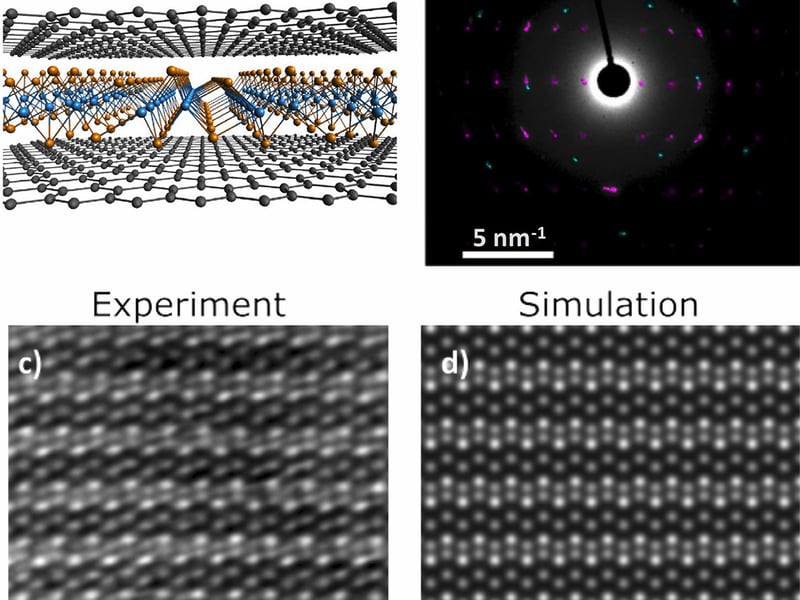
Precise synthetic control of the local electronic structure of metal centers within materials offers the potential to realize exotic physical properties. In particular, tuning the electronic structure of metal centers enables the creation of strongly correlated electron systems, enabling the exploration of fundamental questions about magnetism and superconductivity. In a new seed project within the Northwestern University MRSEC, novel classes of mixed anion materials are being synthesized in an effort to realize new correlated electron properties and related quantum phenomena.
May 4, 2018
Northwestern Materials Research Science and Engineering Center
Polyhedral Assembly of Heteroanionic Materials
A route has been formulated that leverages heteroleptic building units to lift inversion symmetry in heteroanionic materials from balancing short-range and long-range interactions favoring octahedral tilting in perovskite-derived structures. The resulting increase in the number of noncentrosymmetric (NCS) materials is important for improving the performance of compounds found in actuator, imaging, and data storage technologies.
May 3, 2018
Northwestern Materials Research Science and Engineering Center
Computational Discovery of New Oxychalcogenide Compounds
High-throughput density functional theory (DFT) calculations are used to accelerate the discovery of new oxychalcogenide compounds. In particular, experimentally-known crystal structures are decorated with essentially all possible combinations of elements in the periodic table, generating thousands of potential compounds.
May 3, 2018
Northwestern Materials Research Science and Engineering Center
Electronic Coupling in Organic-Transition Metal Dichalcogenide Heterojunctions
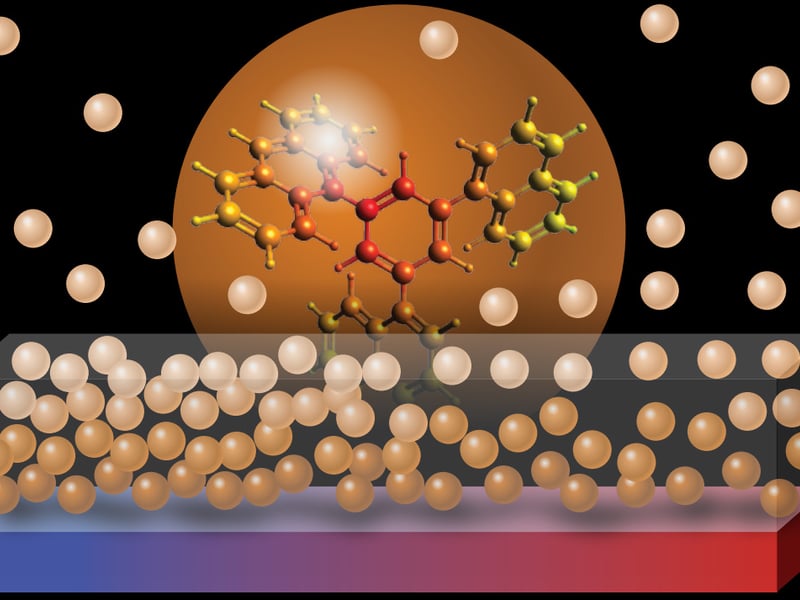
Heterojunctions containing two-dimensional materials can give rise to unique effects at the interface or enhance existing optical properties of the composite layers. Using organic molecules in these heterojunctions has the advantage to enable synthetically tunable electronic and optical properties.
May 3, 2018
Northwestern Materials Research Science and Engineering Center
Reconfigurable 2D Materials with Neuromorphic Functionality
Solid-state electronics and advanced computation has spurred significant interest in artificial intelligence and neuromorphic (i.e., brain-like) computing. However, the deterministic correlations between input and action in conventional silicon microelectronics are not well-matched to information processing in biological systems.
May 1, 2018
Harvard Materials Research Center (2014)
Forward-looking Metalens
David R. Clarke (Materials Science)
Inspired by the human eye, a team led by Clarke at the Harvard MRSEC has reported in Science Advances an adaptive metalens that is a flat, electronically-controlled artificial eye. This new lens which combines breakthroughs in artificial muscle and lens technologies simultaneously controls focus, astigmatism, and image shift.
May 1, 2018
Harvard Materials Research Center (2014)
Crushing Soda Cans: Predicting the Stability Landscape of Shell Buckling
Michael P. Brenner (AppMath), John W. Hutchinson (MechEng), and Shmuel M. Rubinstein (AppPhy)
Crushing a soda can from top to bottom is easier if it is dented initially on the side. Predicting the force needed to crush a dented can, however, which is of critical importance for structural reliance of materials engineering is quite challenging.
Apr 27, 2018
MIT Center for Materials Science and Engineering (2014)
Strong Electric Fields Tune the Stability of Ionic Defects in Oxides
Bilge Yildiz and Krystyn Van Vliet
Intellectual Merit:
No ceramic crystal is perfect, and structural imperfections including point defects are responsible for many technologically desirable properties of ceramics. Applications such as modern computer memories rely on controlling defects inside a crystal by exposing them to large electric fields. High field effects on defective crystals, however, remain challenging to control and address.
Showing 421 to 430 of 1394