Highlights
Apr 25, 2018
UNL Materials Research Science and Engineering Center (2014)
NanoThermoMechanical Thermal Computing
Sidy Ndao (University of Nebraska-Lincoln)
Limited performance and reliability of electronic devices at extreme temperatures, intensive radiation found in space exploration missions and earth-based applications requires the development of alternative computing technologies. Nebraska MRSEC researchers have designed and prototyped the world’s first high-temperature thermal diode. They have demonstrated the use of near-field thermal radiation from smooth and metamaterial surfaces to achieve thermal rectification at high temperatures. They named the technology NanoThermoMechanical thermal computing.
Apr 25, 2018
UNL Materials Research Science and Engineering Center (2014)
Nebraska MRSEC Puts a “Spark” in Summer Learning
Rebecca Lai, Jocelyn Bosley, and Krista Adams (University of Nebraska-Lincoln)
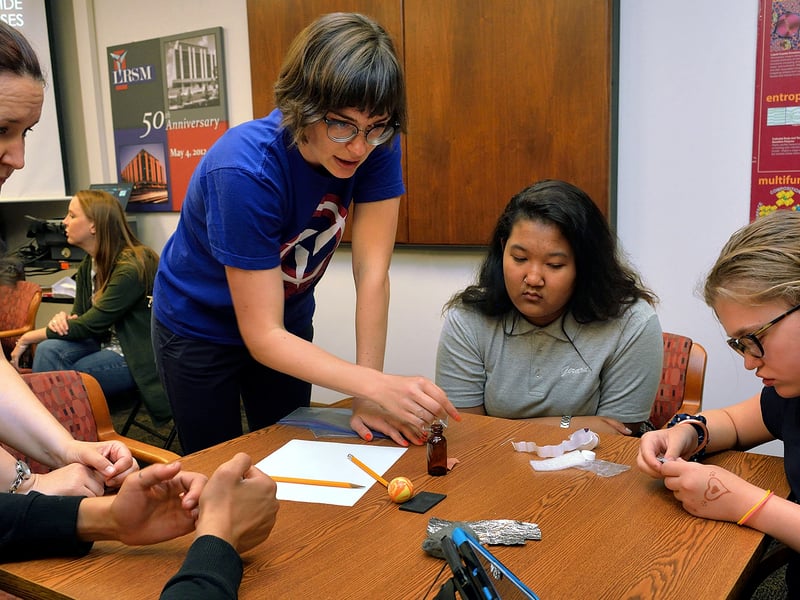
In Summer 2017, Nebraska MRSEC partnered with the Foundation for Lincoln Public Schools to offer a new, STEAM-based summer learning program. Spark Summer Learning provides opportunities for students in grades K-5 to explore science, technology, engineering, art, and math in an immersive setting, engaging students in problem-based learning through hands-on “maker” projects.
Apr 25, 2018
UNL Materials Research Science and Engineering Center (2014)
Optical Control of Polarization in Hybrid 2D-Ferroelectric Structures
Alexei Gruverman and Alexander Sinitskii (University of Nebraska-Lincoln) and Chang-Beom Eom (University of Wisconsin-Madison)
Switchable electric polarization of ferroelectric materials can serve as a state variable in advanced electronic systems, such as non-volatile memories and logic. Control of ferroelectric polarization by external stimuli is the key component for these systems. Nebraska MRSEC researchers have discovered an optical control of the hybrid structures comprising a two-dimensional (2D) semiconducting material, molybdenum disulfide (MoS2), and ultrathin ferroelectric barium titanate (BaTiO3).
Apr 25, 2018
UNL Materials Research Science and Engineering Center (2014)
Direct Observation of Ferrimagnetism in a Multiferroic Hexagonal Ferrite
Xiaoshan Xu, Peter Dowben, and Evgeny Tsymbal (University of Nebraska-Lincoln)
Multiferroics is a class of materials that exhibits a coexistence of electric and magnetic polarizations. Coupling of these polarizations is potentially useful for energy-efficient information storage and processing. Hexagonal rare-earth ferrites (h-RFeO3, where R is rare-earth element and Fe is iron) are new family of multiferroic materials. Magnetic interactions between rare-earth and iron ions in h-RFeO3, may amplify the weak ferromagnetic moment of iron, making these materials more appealing as multiferroics.
Apr 25, 2018
UNL Materials Research Science and Engineering Center (2014)
Nebraska MRSEC Facility: Synthesis and Characterization of Graphene-Like Boron-Carbon-Nitrogen Monolayers
Axel Enders, Peter Dowben, and Alexander Sinitskii (University of Nebraska-Lincoln)
The emergence of two-dimensional (2D) materials, which are only one atom or one structural unit cell thick, has stimulated an enormous range of research effort. The well-known example is graphene – a zero band gap semiconductor, which exhibits outstanding charge carrier mobility. However, the absence of a band gap is a major hindrance in implementing graphene in 2D electronics. The question arises whether other graphenic systems of mono-atomic thickness, with useful electronic properties, can be realized.
Feb 12, 2018
Cornell Center for Materials Research (2017)
Threading Atom-Wide Wires Into 2D Materials
Cornell University researchers and collaborators have discovered – somewhat accidentally – a method for inserting a one-dimensional (1D) semiconductor channel into the “fabric” of a material that is only a few atoms thick.
Aug 23, 2017
Princeton Center for Complex Materials (2014)
Día De la Ciencia / Science Day - bilingual event at Princeton's MRSEC
Daniel Steinberg, Princeton Center for Complex Materials (PCCM)
On April 8, 2017, PCCM held its first Día de la Ciencia at the Princeton Public Library. Forty scientists set up 20 table presentations and met with over 500 members of the community. In an attempt to improve outreach to all members of the community, PCCM organized the Día de la Ciencia event to reach the large Latino/Latina population in the town of Princeton, NJ and surrounding region. PCCM piloted Día de la Ciencia with science demos and had at least one Spanish speaking presenter at each table.
Aug 23, 2017
Princeton Center for Complex Materials (2014)
Imaging and Analysis Center Partners with Industry and Other Institutions
Nan Yao (Princeton University)
The Imaging and Analysis Center (IAC) supported by PCCM is a world-leading facility for materials characterization. It is a critical resource to our industrial user community. The advanced instrumentation and expertise in the IAC provide ultimate opportunity for us to actively interact with industrial scientists. IAC conducts a series of short courses (required for instrument access), which involve direct experimental demonstrations and hands-on instruction, ranging from basic sample preparation devices to high-end electron microscopes.
Aug 23, 2017
Princeton Center for Complex Materials (2014)
Stars of Materials Science with Professors Cliff Brangwynne and Rod Priestley
Daniel Steinberg, Princeton Center for Complex Materials (PCCM)
On April 1, 2017 over 500 people visited Princeton University to learn about polymers from Princeton Center for Complex Materials researchers. Members of the NSF funded MRSEC in Interdisciplinary Research Group 2 presented a multimedia demonstration and lecture featuring audience participation. Rod Priestley and Cliff Brangwynne spent months developing the presentation that explained the basics of polymers, discussed their career paths in science and overviewed their MRSEC research on a level that a 5 year old to an adult could understand and appreciate.
Aug 23, 2017
Princeton Center for Complex Materials (2014)
New Color Centers in Diamond for Quantum Information Science
Nathalie P. de Leon and Stephen A. Lyon (Princeton University)
Color centers in diamond are a promising platform for quantum information science, as they can serve as solid state quantum bits with efficient optical transitions. Much recent attention has focused on the negatively charged NV center in diamond, which can be measured and initialized optically, exhibits long spin coherence times at room temperature, and has narrow, spin-conserving optical transitions.
Showing 431 to 440 of 1394