Highlights
May 13, 2016
Wisconsin Materials Research Science and Engineering Center
MRSEC Shared Facilities: A Vital Resource
Jerry Hunter, University of Wisconsin-Madison
The resources of the Wisconsin MRSEC Shared Facilities impact researchers campus-wide and beyond. Over the past year >79,000 usage hours accounted for:
May 13, 2016
Wisconsin Materials Research Science and Engineering Center
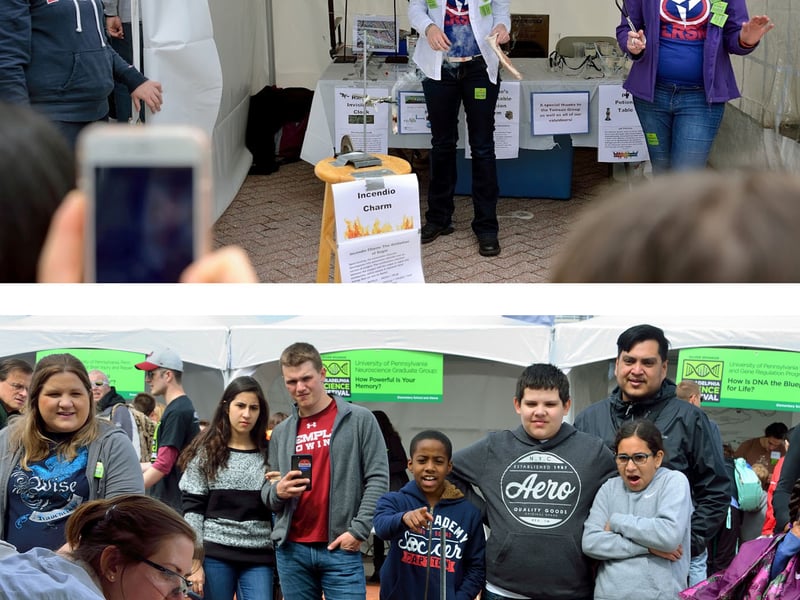
Wisconsin MRSEC Outreach Impacts 255,000 People This Year!
Anne Lynn Gillian-Daniel, Benjamin Taylor University of Wisconsin-Madison
Since 2011, the Wisconsin MRSEC has created over 40 unique research-inspired education resources. These resources are disseminated through educational kits, outreach activities, instructional videos and other online resources, all based on cutting-edge research going on in the Wisconsin MRSEC.
These resources have impacted:
>650,000 people in 194 countries.
Over the last year:
May 13, 2016
Wisconsin Materials Research Science and Engineering Center
Templating Nanomaterials from Defects in Liquid Crystals
Nicholas L. Abbott, Juan J. de Pablo*, University of Wisconsin-Madison, *University of Chicago
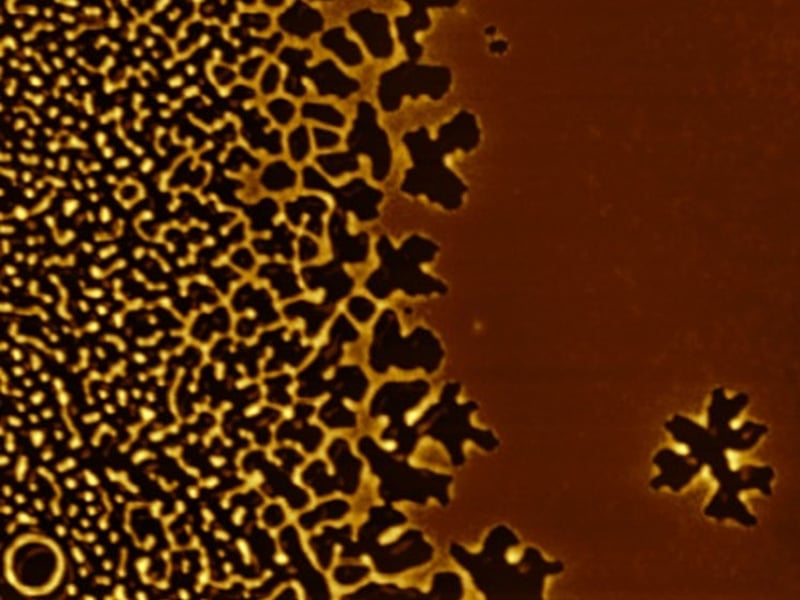
Defects in liquid crystals can function as nanoscopic molds for assembling molecules
May 13, 2016
Wisconsin Materials Research Science and Engineering Center
Full Circle of Innovation in Instrumentation: Atomic Level Imaging
Susan E. Babcock, Thomas F. Kuech, University of Wisconsin-Madison
A MRSEC innovation comes back home to reveal the atomic structure of new materials
May 5, 2016
UMN Materials Research Science and Engineering Center (2014)
Efficient and uniform doping of zinc oxide nanocrystals via plasma synthesis
Eray Aydil, Uwe Kortshagen, Andre Mkhoyan
In solution-based synthesis, often doping efficiencies are low and dopants are excluded from the nanocrystals’ central cores. The research team developed a fundamentally different plasma-based process for synthesizing aluminum-doped zinc oxide nanocrystals.
May 4, 2016
UMN Materials Research Science and Engineering Center (2014)
How many electrons make a nanocrystal film metallic?
Uwe Kortshagen, Boris Shklovskii (IRG-2)
Understanding the transport of electrons in films of touching nanocrystals is of central importance for their future use in printed electronic devices such as light emitting diodes, solar cells, or transistors. The research team developed a new theory that describes the transition of the electron conduction in doped nanocrystal films from a semiconducting to a metallic behavior.
Apr 28, 2016
Next Generation Materials for Plasmonics and Organic Spintronics (2011)
Terahertz Conductivity Measurements of the High Electron Density at the Interface Between Complex Oxides Berardi Sensale-Rodriguez and Ajay Nahata
Berardi Sensale-Rodriguez and Ajay Nahata, University of Utah Dept. of Computer and Electric Engineering
Objective: Explore the potential for obtaining very
high electron concentrations at the interface between two complex oxides and
examine its relevance for terahertz (THz) applications.
Apr 28, 2016
Next Generation Materials for Plasmonics and Organic Spintronics (2011)
Pulse Inverse Spin-Hall Effect in Organic Semiconductors
Christoph Boehme and Z. Valy Vardeny, University of Utah, Dept. of Physics and Astronomy
Objective: Estimate spin-orbit coupling in in a wide variety of organic semiconductors.
Apr 28, 2016
Next Generation Materials for Plasmonics and Organic Spintronics (2011)
Presenting Undergraduate Research at the National Level
Chelsey Short, University of Utah MRSEC
Objective: Train
Utah MRSEC students to effectively present materials research.
Showing 551 to 560 of 1394