Seed
The Center operates an ambitious Seed program designed to foster innovation and promote Center growth and evolution. Awards are made to individual faculty members or small clusters in support of high risk projects or research in emerging areas.
CRISP: Center for Research on Interface Structures and Phenomena (2005)
The Center for Research on Interface Structures and Phenomena [CRISP] is a single-IRG Center that focuses on complex oxide interfaces and the wealth of new science and applications that they offer. Using the experimental and theoretical resources of three institutions, including atomic-scale imaging, the Center addresses the electronic, magnetic and chemical properties of complex oxides and their interfaces, along with possible applications in areas such as magnetic storage, "spintronics", chemical sensing and electronic devices. The Center also explores new manifestations of the field effect, the ability to modify the properties of an oxide surface by application of a strong electric field. The Center has extensive education and outreach activities that use materials science as a vehicle for enhancing scientific literacy. They include providing research experience to local New Haven high-school science teachers; a summer research program in which undergraduates, graduate students, faculty and industrial partners work together on materials science projects; public lectures; science courses for undergraduate non-science majors; and interactive museum displays.
Atomic Membranes for 3D Systems
IRG Senior Participants:
Paul McEuen (Phys, co-leader), David Muller (ApplPhys, co-leader), Itai Cohen (Phys), Erik Demaine (Math & CompSci, MIT), Robert DiStasio, Jr. (Chem), Jiwoong Park (Chem, UChicago).
Collaborators: Nicholas Abbott (Cornell), Markus Buehler (MIT), Robert Lang (Lang Origami), Gerard van Veen (Thermo Fisher, Netherlands), Alexandre Tkatchenko (Phys/MatSci, Luxembourg).
Atomic membranes are a new class of two-dimensional, free-standing materials only one atom thick yet mechanically robust, chemically stable, and virtually impermeable. The prototype atomic membrane is graphene, a honeycomb lattice entirely made of carbon atoms, but other emerging systems such as the III-V boron nitride (BN) materials offer exciting new properties. The central aim of this IRG is to extend miniaturization to its ultimate limit by creating atomically thin 2D “paper” materials that self-fold into incredibly responsive 3D structures with lateral features spanning the mm to nm scales. To accomplish this goal, this IRG will perform the basic materials growth, characterization, and design to make this revolution possible. In specific, we will: (i) synthesize and characterize novel 2D atomic membranes (2D-AMs), analogous to the different kinds of colored paper in origami, (ii) develop approaches to bend and fold these 2D-AMs in response to environmental or external signals, and (iii) elucidate general design approaches to create 3D structures that could ultimately be used for devices with novel physical, optical, electrical, and/or chemical functionalities. Achieving these goals will require new strategies for self-folding as we deepen our understanding of the increasingly more important roles played by van der Waals (vdW) forces and thermal fluctuations at these length scales. Our approach will build on the fact that biological nanosystems (e.g., proteins and DNA/RNA) adapt to this regime by working in aqueous solutions. Such dynamic liquid environments will allow us to unfold and actuate these complex nanostructures.
See Related TED Talk, "Tiny Robots with Giant Potential."
Topological Quantum Matter
Topological and interacting quantum materials provide tremendous opportunities for the discovery and manipulation of new electronic phenomena. Underscoring these potential opportunities is the realization that topological properties can protect quantum states and novel excitations, where information and entanglement can be uniquely encoded to be more resistant to environmental decoherence. To predict and discover novel quantum states in materials requires a multidisciplinary approach, which will be executed by combining the theoretical methods of Haldane, Bernevig, Lian, and Sheng, together with materials synthesis by Schoop and Cava (supplementary crystal growth by Koohpayeh), and transport and spectroscopic measurements by Ong, Wu and Yazdani, with angle-resolved photoemission spectroscopy (ARPES). The materials studied will include spin liquid systems, novel 2D systems and their twisted stacks, topological superconducting systems, nonsymmorphic materials, and 3D novel quantum lattices. With this broad range of materials systems, the IRG will explore exotic neutral modes in fractionalized insulators, explore new topological quantum states in correlated flat-band electronic systems, and detect Majorana fermions and the novel edge modes of topological superconductors. The IRG will also search for and synthesize new materials, with a focus on the topological properties of magnetic systems, which have not been well investigated. The IRG’s efforts in materials discovery will be augmented by the application of machine learning techniques, combined with topological quantum chemistry -- a new theoretical approach to aid in the discovery of topological materials that has resulted in an expansive database of potential materials to be explored.
Co-Leaders
N. Phuan Ong, co-leader (Physics)
Leslie Schoop, co-leader (Chemistry)
Senior Investigators
B. Andrei Bernevig (Physics)
Robert Cava (Chemistry)
F. Duncan M. Haldane (Physics)
Biao Lian (Physics)
Donna N. Sheng (Cal. State University-Northridge)
Sanfeng Wu (Physics)
Ali Yazdani (Physics)
Collaborators
Claudia Felser (Max Planck Inst., Dresden, Germany)
David Mandrus (The University of Tennessee)
Stephen Nagler (Oak Ridge National Lab)
Max Hirschberger (University of Tokyo, Japan)
Yu-Min Hu (Tsinghua University, China)
Pascal Manuel (ISIS Neutron & Muon Facility, STFC Rutherford Appleton Lab, UK)
Florian Pielnhofer (University of Regensburg, Germany)
Nicolas Regnault (École Normale Supérieure, Physique, Paris, France)
Andrei Varykhalov (Helmholtz-Zentrum Berlin, Germany)
Maia Vergniory (Donostia International Physics Center, Spain)
Seed 4: A Lithium Solid-State Memristor - Modulating Interfaces and Defects for Novel Li-Ionic Operated Memory and Computing Architectures
A Lithium Solid-State Memristor - Modulating Interfaces and Defects for Novel Li-Ionic Operated Memory and Computing Architectures
Jennifer L.M. Rupp, Assistant Professor, Department of Materials Science and Engineering
This project focus is on the research of lithium ionic carrier and defect kinetics in oxides to design material architectures and interfaces for novel "Li-operated memristors as alternative memory and non-binary computing architectures". The digital revolution relies on fast and efficient data collection, storage, and information transfer. Since the early days of computers, information is processed in logic elements that are built up from electronically controlled transistors based on binary states. However, further down-scaling of transistors will soon be prohibited by physical limits as well as their increasing power demand. Here, the use of ionically-controlled memristors – nanometersized and analog – could allow for the realization of highly functional, low-energy circuit elements operating on multiple resistance states and to encode information beyond binary.
Memristors are resistive elements whose structure is typically composed of a transition metal oxide thin film sandwiched between two metallic electrodes. The application of a sufficiently high electric field induces a non-volatile resistance change linked to locally induced redox processes in the oxide. Through varying the voltage amplitude and duration, several distinct resistance levels can be achieved in the memristor by formation of either conductive filaments with ionic carriers (mostly O2−, Ag+ or Cu2+) or their charge/defect accumulation at the oxide/electrode interfaces in the device. The fingerprint of a memristor is an hysteretic current-voltage profile, which depends on the magnitude, polarity and time range of the applied voltage to the metal/oxide/metal structure, defining the redistribution of ionic carriers and defects in the device. Key challenges to replace today`s electronic transistors by ionic memristors are the low retention of addressable resistance states (caused by e.g. unstable charge potentials at the interfaces) and lack in understanding of charge/mass transfer kinetics at high electric fields driving future switching times and energy consumption. Only limited defect chemistry and ion migration kinetics studies exist for oxides and interfaces under high electric fields; also the nature of switching ions (e.g. from host lattice vs. other mobile ions require attention).
The idea of this research is to design, fabricate and investigate Li-based memristors based on monolayers and heterostructures of Li-oxides with controllable space charge potentials at their interfaces. For this, as the first part of this research, we make and study Li-oxide films with variable capacitance, operation voltage range and Li-ionic transfer kinetics under high electric field strengths and probe their memristive function. We will then assess their Li space-charge potentials at the interfaces, structural stability, retention and defect formation as they form the backbone to the Li-heterostructure memristor concept in the second project part. Methods for thin film fabrication and for probing structure-defect-carrier properties of Li-oxides and their interfaces by ex-situ techniques and also novel in-operando electrochemistry/wavelength-dependent Raman spectroscopy are discussed. Innovative and interdisciplinary opportunities for collaboration with CMSE/MIT faculty are highlighted.
The innovation in this research will be in making the first Li-memristors/resistive switches based on heterostructures with systematically altered space charge potentials by alternations of width and extension of high Li-capacitive monolayers and low Li capacitive/fast conductive monolayers. The outcome of this research will produce systematic model experiments to understand role of Li/defect space charges for memristors and a new strategy to increase retention by number of Li heterostructure interfaces on resistive switching and potentially number of addressable states.
Harnessing Disordered Macromolecular Structures for Living and Soft Matter
Biological systems are structurally disordered and rheologically complex, with architectures ranging from the scales of molecules to tissues, yet they self-assemble and function robustly in a coordinated manner. The field of soft matter science provides a framework for understanding the diverse mechanical and transport properties of living systems, both at the intracellular and extracellular scales. This IRG will use this materials-centric perspective to determine new "Rules of Life" and develop new insights for the control of soft materials, which are inherently multi-component, disordered, and often out of equilibrium. The integration of biology and materials science is reflected in the fields of expertise of the investigators and collaborators (experimentalists and theorists) who form an interactive community at Princeton.
The team will focus on macromolecules that form solutions and gels with key rheological properties that serve as fundamental building blocks of soft and living materials. Biological polymers, such as proteins and nucleic acids, have diverse intracellular (e.g., gene regulation) and extracellular (e.g., biofilm matrices) functions, which are connected to structural features like molecular weight, chain architecture, charge distribution, monomer sequence, and cross-linking. This IRG will bridge materials science and biology to address how macromolecular properties determine and control material functions at two scales of biological organization – the intra- and extracellular levels – and to inspire new materials insights.
The research addresses two key questions: 1) How is the formation of multiple condensed phases controlled in macromolecular solutions containing passive and active components? 2) How do macromolecular gels regulate form and function in multicomponent and active systems? These themes span the common fluid and elastic materials that exist throughout biology and constitute many novel soft materials. The IRG’s combined experimental, computational and theoretical approaches to answer these questions will enable insights into understanding the "Rules of Life" by demonstrating how macromolecules regulate gene expression, aggregation of pathological proteins, cellular transport, and formation of multicellular communities. The IRG will provide materials science insights into how macromolecules can be combined with active components and optogenetic control to design new responsive systems with tunable properties. The IRG’s integration of tools and insights will support the foundation for the emerging field of “living materials science."
Co-Leaders
Howard Stone (MAE)
Sujit Datta (CBE)
Senior Investigators
Bonnie Bassler (Mol-Bio)
Clifford Brangwynne (CBE)
Sujit Datta (CBE)
Mikko Haataja (MAE)
Jerelle Joseph (CBE)
Andrej Košmrlj (MAE)
Celeste Nelson (CBE)
Athanassios Panagiotopoulos (CBE)
Rodney Priestley (CBE)
Richard Register (CBE)
Collaborators
Anderson Shum (The University of Hong Kong, Hong Kong)
Evgeniy Boyko (Technion - Israel Institute of Technology, Israel)
Zheng Shi (Rutgers University)
Analysis and Design of Genetic and Metabolic Control Systems of Bacterial Cells
Molecular biology permits custom programming of cells to carry out specific tasks, such as synthesis of specific biomolecules or modification of molecules in the extracellular environment. Further examples include formation of multicellular structures or sending chemical or optical signals in response to detection of specific molecules. The bacterium Escherichia coli, for which there exists a staggering array of genetic engineering methods and genomic data, is well suited for such tasks. Efforts at bioengineering of E. coli depend on understanding unresolved basic questions of the mechanisms underlying control of gene expression (i.e., modulation of which genes are expressed at any given time, largely through DNA-protein interactions on the chromosome) and metabolic processes (i.e., the biochemical reaction pathways through which the basic molecules of a cell are processed). The overall objective of this project is to biologically engineer bacterial cells, and design them to perform specific tasks and to produce specific materials. Two complementary projects focus on understanding mechanistic aspects of gene expression and metabolic processes in E. coli. Key strengths of the project are the complementary abilities of the collaborating groups in the areas of theoretical study of metabolic and genetic networks of E. coli, study of information in genetic sequences, theoretical and experimental study of protein-DNA interactions at the single-molecule level, experimental study of chromosome structure and function, and theoretical and experimental study of soft materials including supramolecular assemblies of biomolecules.
IRG 1: AI-Driven Design of Quantum Materials
Molecular Packing and Efficient Triplet Harvesting in Singlet Fission(SEED 6)
Seed 6 will examine the molecular packing and efficient triplet harvesting in singlet fission. The work will identify both favorable and unfavorable molecular packing for singlet fission.
Principal Investigators
Greg Scholes (Chemistry)
Lynn Loo (Chemical and Biological Engineering)
* This seed is inactive.
IRG 1: Peptide Active Materials (PAMs)
Motivation and Impact
Harnessing the immense polyaminoacid complexity of nature and beyond without billions of years of evolution
Nature Inspired Materials
MOTIVATION:
Life is possible due to proteins: polyaminoacid macromolecules with exquisite folded nanostructure producing specific function that is encoded in the amino acid sequence.
KEY CHALLENGE:
Restricted toolbox of natural or mutated protein structures limits design of non-natural materials.
VISION:
Computational design to realize synthetic peptides that fold and assemble into rigid, protein-like building blocks to produce designed Nanostructure (Aim 1), Motion (Aim 2), and Simple Machines (Aim 3).
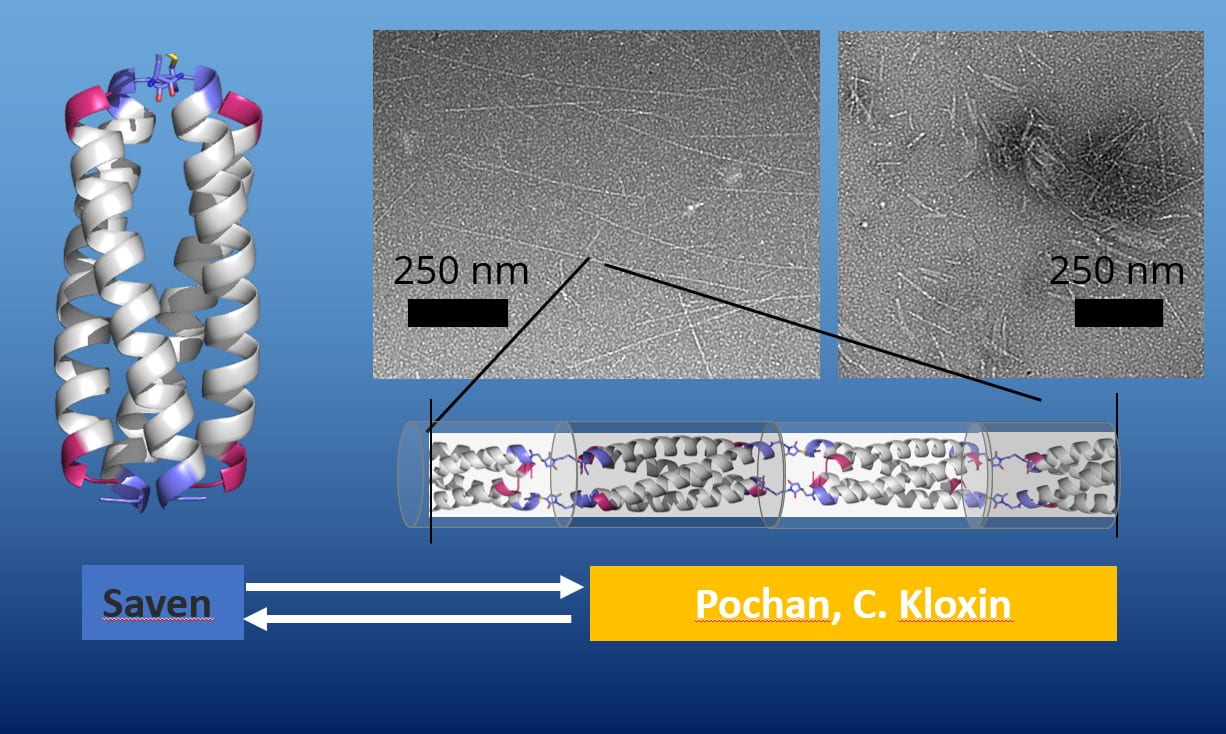
Saven, C. Kloxin, Pochan, and coworkers, “Polymers with controlled assembly and rigidity made with click-functional peptide bundles,” Nature 574 (2019): 658-662
Showing 1161 to 1170 of 2653