Brown's Center for Advanced Materials Research (2000)
The Materials Research Science and Engineering Center (MRSEC) at Brown University supports an interdisciplinary research program on the mechanics of materials at the atomistic and microstructural level. The research is carried out in one interdisciplinary research group, with appropriate seed projects. Within the IRG one major thrust is the study of the effect of stress on the performance of electronic nanostructures and nanodevices. This research has potential impact on understanding how stress effects the design and performance of atomic scale sized lasers and electronic devices. The experimental results are modeled using the quasicontinuum model developed at Brown. The second thrust in the IRG is concerned with the investigation of the micromechanics of materials with complex microstructures. Emphasis is on the interface between two types of systems such as bicrystals of aluminum, aluminum alloy, and synthetic bimaterials. Computational techniques closely support the experimental efforts. The center is engaged in a variety of educational activities, notably the development aterials science teaching modules aimed at the high school level and the training of secondary teachers in use of the modules. The Center supports well maintained shared experimental facilities, which are accessible to outside users and also supports interactive efforts with industry and other sectors.
Stability in Glasses
Glasses are ubiquitous across materials types and technological applications but their structure – property – processing relationships and underlying fundamental physics remain poorly understood. IRG 1 uses cross-fertilization of ideas and techniques from organic and inorganic glasses to address fundamental problems in glass science through the lens of stability. Glasses of the same composition can be created in states of widely varying thermodynamic and kinetic stability.
The IRG seeks to use these materials to develop fundamental stability-structure-property relationships for glasses. Efforts include establishing control over stability in organic and inorganic glasses; understanding the structures associated with varying states of stability; discovering the molecular nature of polyamorphism – the existence of two stable liquid states of the same substance; and determining the relationship between the structure and dynamics of liquids as they cool into the glassy state. The IRG integrates theory, simulations, and experiments to expand the range of ultrastable glassy materials and to enable new applications in areas as diverse as hard coatings and quantum information.
IRG-2: Mesoscale Network Materials
The goal of IRG-2 is to discover and exploit scale-invariant shape-filling amphiphile (SFA) motifs to assemble robust, functional network phases and to understand how processing impacts their properties.

IRG-1: Complex Concentrated Materials
IRG-1 will develop the fundamental science needed to understand, describe, and predict interfacial phenomena in metals and ceramics with multiple principal elements. These so-called complex concentrated materials have been reported to have outstanding properties such as high strength, tailored band gaps, extremely large dielectric constants, and substantially reduced thermal conductivity, making them the next paradigm shift in structural and functional materials.
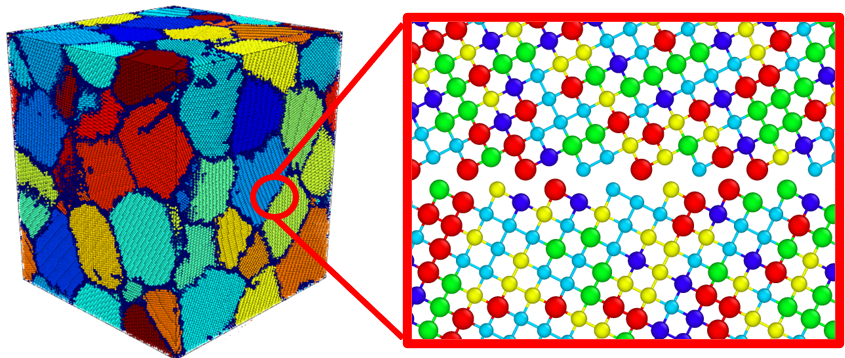
Fig. Interfacial Science of Complex Concentrated Materials
This IRG’s interdisciplinary team will be the first to develop the core principles of microstructural engineering for complex concentrated materials, including fundamental investigations of atomic-level structure and chemistry, interfacial thermodynamics, kinetics, and mechanical and functional properties. This foundational knowledge will then be used to design and synthesize materials with planned microstructures and properties.
The team provides complementary expertise in materials theory, computational materials science, processing science, advanced characterization, property measurement, and artificial intelligence to enable a complete study of interfacial behavior in complex concentrated materials. This IRG is expected to transform complex concentrated materials from laboratory curiosities into materials that alter our global economy in a variety of essential industries.
UMN Materials Research Science and Engineering Center (2008)
The Materials Research Science and Engineering Center (MRSEC) at the University of Minnesota (UMN) unites established senior and promising junior faculty from six departments and two other universities in a multidisciplinary program to address fundamental issues spanning a broad spectrum of materials research. The research mission of the Center is founded upon four Interdisciplinary Research Groups (IRGs):
IRG-1: Engineered Multiblock Polymers implements powerful synthesis and processing strategies for advanced materials based on self-assembly of multiblock copolymers. These new materials may be used for controlled porosity membranes and drug delivery.
IRG-2: Organic Optoelectronic Interfaces is developing a comprehensive understanding of structure-property relationships in a new generation of electronic materials.
IRG-3: Magnetic Heterostructures explores spin transport, spin transfer torque, and novel highly polarized materials in precisely engineered heterostructures. This may lead to new magnetic memory devices and new paradigms in computation.
IRG-4: Nanoparticle-based Materials is creating environmentally benign nanoparticle-based materials for applications in luminescence and photovoltaics.
The UMN MRSEC manages an extensive program in education and career development. Center research activities are integrated with educational programs, providing interdisciplinary training of students and postdocs. The summer research program features four distinct efforts, two of which, Faculty-Student Teams; Native American Fellowships, target Tribal Colleges. The Research Experiences for Undergraduates and Research Experiences for Teachers programs also attract a significant population of female and underrepresented minority undergraduates to the University.
MRSEC faculty and student participate in numerous K-12 outreach activities that include a program of summer camps for high school students and working with the Science Museum of Minnesota in developing exhibits, providing demonstrations, and staffing booths.
The MRSEC is bolstered by a broad complement of over 35 companies that contribute directly to IRG research through intellectual, technological, and financial support in a collaborative and pre-competitive environment through the Industrial Partnership for Research in Interfacial and Materials Engineering (IPRIME) and the Center for Micromagnetics and Information Technologies (MINT). International research collaborations and student exchanges are pursued with leading research labs in Asia and Europe. The UMN MRSEC benefits from an extensive suite of materials synthesis, characterization and computational facilities.
Cornell Materials Science and Engineering Research Center (1996)
The Materials Research Science and Engineering Center (MRSEC) at Cornell University supports interactive research in four interdisciplinary groups. The theme of the MRSEC is the understanding and control of materials at the nanostructural level. The Center supports an extensive program of research experience for undergraduates and a new program of outreach to pre-college students in upstate New York, including collaborative efforts with a local science museum. The Center will also support seed funding for exploratory research and emerging areas of materials science. The MRSEC supports enhanced collaboration with industry and extensive shared experimental facilities that also support research not directly funded by the MRSEC. As part of the Center's search for new materials, the molecular inorganic- organic composites group will focus on innovative approaches for preparing and characterizing novel nanoscale inorganic-organic molecular composites. The group studying thin films on glass proposes systematic studies of disordered surfaces and thin film deposition on glass. The research addresses a rich array of phenomena that are not currently understood, and has potential application for large area electronics, a growing segment of the communications and display industry. Thin film deposition by energetic ion and atom beams can alter thin film growth substantially, leading to new structures, new compositions, and smooth ultra-thin films with improved properties. This group seeks to understand the microscopic processes underlying these effects. Uniquely structured nanoscale materials that isolate a few defects (or even a single one) will be used by the metallic nanostructure group to elucidate fundamental issues arising from defects and impurities. Magnetic interactions, defects and impurities can produce dramatic effects in quantum systems. The Center currently supports about 35 senior investigators, 8 postdoctoral research associates, 12 t echnicians or other professionals, 36 graduate students, and 25 undergraduates. The MRSEC is directed by Professor John Silcox. %%% The Materials Research Science and Engineering Center (MRSEC) at Cornell University supports interactive research in four interdisciplinary groups. The theme of the MRSEC is the understanding and control of materials at the nanostructural level. The Center supports an extensive program of research experience for undergraduates and a new program of outreach to pre-college students in upstate New York, including collaborative efforts with a local science museum. The Center will also support seed funding for exploratory research and emerging areas of materials science. The MRSEC supports enhanced collaboration with industry and extensive shared experimental facilities that also support research not directly funded by the MRSEC. As part of the Center's search for new materials, the molecular inorganic- organic composites group will focus on innovative approaches for preparing and characterizing novel nanoscale inorganic-organic molecular composites. The group studying thin films on glass proposes systematic studies of disordered surfaces and thin film deposition on glass. The research addresses a rich array of phenomena that are not currently understood, and has potential application for large area electronics, a growing segment of the communications and display industry. Thin film deposition by energetic ion and atom beams can alter thin film growth substantially, leading to new structures, new compositions, and smooth ultra-thin films with improved properties. This group seeks to understand the microscopic processes underlying these effects. Uniquely structured nanoscale materials that isolate a few defects (or even a single one) will be used by the metallic nanostructure group to elucidate fundamental issues arising from defects and impurities. Magnetic interactions, defects and impurities can produce dramatic effects in q uantum systems.
Arizona State University Materials Research Science and Engineering Center (1996)
The Material Research Science and Engineering Center (MRSEC) at Arizona State University supports research on the synthesis of new families of materials, with a focus on the synthesis of materials at high pressures. The research combines experimental and theoretical studies to predict the stability, properties, and appropriate pressure range for the synthesis of novel target phases of nitride glasses, oxide perovskites, carbon nitrides, and chalcogenides. Additional research efforts address the process of vitrification in amorphous materials and the synthesis and characterization of epitaxial nitride films. The MRSEC supports shared experimental facilities for materials research, exploratory research through seed funding, and collaborations with industry and other academic institutions. Educational outreach programs include development of educational modules on materials science for middle school students and a collaborative research program with the College of Eastern Utah. The Center supports 13 senior investigators, 4 postdoctoral research associates, 12 graduate students, 1 technician, and 5 undergraduates. The MRSEC is directed by Prof. Paul McMillan. %%% The Material Research Science and Engineering Center (MRSEC) at Arizona State University supports research on the synthesis of new families of materials, with a focus on the synthesis of materials at high pressures. The MRSEC supports shared experimental facilities for materials research, exploratory research through seed funding, and collaborations with industry and other academic institutions. Educational outreach programs include development of educational modules on materials science for middle school students and a collaborative research program with the College of Eastern Utah. The Center supports 13 senior investigators, 4 postdoctoral research associates, 12 graduate students, 1 technician, and 5 undergraduates. The MRSEC is directed by Prof. Paul McMillan.
CU Boulder Ferroelectric Liquid Crystal Materials Research Center (2002)
The Materials Research Science and Engineering Center (MRSEC) at the University of Colorado, The Ferroelectric Liquid Crystal Materoals Reserach Center, focuses on basic liquid crystal and soft materials science that may result in enhanced capabilities for electro-optic, nonlinear optic, chemical and other applications. The Center consists of a single interdisciplinary research group (IRG) working on three major themes: molecularstructure/macroscopic properties, interfaces, and polymers/gels. Each theme integrates molecular modeling and design, synthesis, physical characterization, and applications development. The MRSEC maintains shared facilities in support of its research and for the training of students. The Center carries out a comprehensive education and outreach program that includes outreach to K-12 students and teachers by bringing materials topics to the classroom, summer research experiences for undergraduates, and a graduate program in liquid crystal science and technology. The MRSEC has strong interactions with the industrial sector through research collaborations involving faculty and students.
Participants in the Center currently include 9 senior investigators, 1 postdoctoral associate, 12 graduate students, and 4 support personnel. Professor Noel A. Clark directs the MRSEC.
Molecular Logic for Nanoelectronics
Following the successful demonstration (Nature 2007, 445, 414???417) of a working defect-tolerant 160,000 bit molecular memory composed of a Langmuir-Blodgett (LB) derived monolayer of amphiphilic, bistable rotaxane molecules and fabrication in a crossbar architecture with nanowires (15 nm wide polysilicon underneath and 15 nm wide Ti/Al on top sandwiching approximately 200 molecules) at a density (1011 bits cm-2) not predicted, according to the 2005 International Technology Roadmap for Semiconductors (2005 ITRS), to be reached until 2020 at the earliest, the aim of this research project is to design and synthesize, by template-directed protocols that depend upon the operation of molecular recognition and self-assembly processes, bistable rotaxanes, which are amphiphilic or functionalized for carrying out Huisgen/Sharpless-style ???click chemistry??? with matching electrode surfaces, and undego a change in their dipole moments in response to an electrochemical stimulus that causes relative mechanical motions to occur within the bistable rotaxane molecules. Monolayers of these molecules will then be assessed in a device setting which involves a two-terminal molecular switch tunnel junction (MSTJ) to establish whether or not they can be switched electrically between high and low capacitance states, and hence, in principle at least, can serve as active reconfigurable channels in logic circuits. The research objectives will be reached by controlling the nature and location of the charged components in these nanoelectromechanical systems (NEMS) where control of the dielectric properties of monolayers of these bistable molecules will be achieved through dipole induction and/or charge-storage processes. The compounds that are designed to address reconfigurable molecular logic will also feature a unique collection of recognition units which could be employed to expand the available chemical space for a much wider range of applications addressable by artificial molecular machinery.
Complex Metal Oxides (2017 Center)
Complex metal oxides are a diverse and highly versatile class of materials that can exhibit scientifically and technologically important behaviors ranging from magnetism to piezoelectricity. New technologies and new fields of applications can be realized by expanding the scope of available ionic compositions and increasing the geometric complexity of nanostructures formed from crystalline oxide materials. IRG 2 focuses on probing the synthesis of oxides, increasing the range of available oxide compositions, and forming unique nanostructures – directions that are each enabled by use of novel transformations from the amorphous to crystalline form. This process of solid phase epitaxy, or SPE, allows the crystallization of materials that cannot be made through conventional processing techniques and provides the freedom to develop new materials and explore new properties.
Showing 1171 to 1180 of 2653