Events
Symposium on Soft Matters in Materials Science
The 4th PENN-UPRH PREM Symposium on Soft Matters in Materials Science will take place on Friday May 7th, 2010 in Palmas del Mar, Humacao, Puerto Rico. Six plenary talks will be of
Events
Directors' Meeting October 2011
Agenda Virginia Tech Research Center 900 N. Glebe Road, Arlington VA 22230 East/West Falls Church Room 2:15 PM Overview of the 2011 Materials Research Centers and Teams Competition MRSEC Program Directors 2:45 PM 5 minute presentations from new MRSECs
Events
2008 Robert Maddin Lecture in Materials Science
Cell Nanomechanics & Human Disease States Subra Suresh Dean, School of Engineering Massachusetts Institute of Technology Laboratory for Research on the Structure of Matter Auditorium
Events
October 2008 Directors' Meeting
???The Future of Electronic beyond Moore???s Law??? ???National Science Foundation Room 375, Arlington, Virginia
Events
AQUIFER (AQUial Initiatives for FERroics)
The program will address the lively field of ferroic materials. Examples include but are not limited to (anti)ferromagnets, (anti)ferroelectrics, and ferroelastics. Such materials are characterized either by long-range magnetic or dipolar orders or by a spontaneous strain deformation. In this framework, multiferroics, which display more than one ferroic property, are multifunctional materials that response to more than one external perturbation in a useful way.
Events
Science Café Program 2010-2011
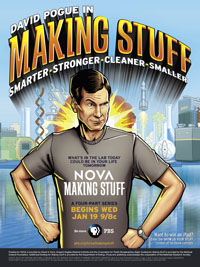
 The LRSM, through the NSF-supported Penn MRSEC, is presenting a series of Science Cafés to promote NOVA’s four part TV series on materials, ‘Making Stuff with David Pogue,’
which will run every Wednesday evening on public television stations
at 9:00 pm starting on January 19, 2011. The Science Cafés, which are
science talks for laymen about materials-related topic of current
interest, will take place at 8:00 pm at Stoney’s British Pub,
3007 Concord Pike, Wilmington DE. These programs are free and anyone
who is interested is invited to attend. No purchase is necessary.
The LRSM, through the NSF-supported Penn MRSEC, is presenting a series of Science Cafés to promote NOVA’s four part TV series on materials, ‘Making Stuff with David Pogue,’
which will run every Wednesday evening on public television stations
at 9:00 pm starting on January 19, 2011. The Science Cafés, which are
science talks for laymen about materials-related topic of current
interest, will take place at 8:00 pm at Stoney’s British Pub,
3007 Concord Pike, Wilmington DE. These programs are free and anyone
who is interested is invited to attend. No purchase is necessary.
Events
Regional Materials Network Workshop
One goal of this workshop is to learn as much as possible about resources and needs at regional institutions. We are lucky enough to have participants from a wide range of institutions, include multiple companies, UW systems schools, and national laboratories. We would therefore like to reach out directly to all of you and ask if you would be interested in presenting some information on your institution’s resources and needs.
Events
Eli Burstein Lecture with Paul M. Chaikin
The Annual Eli Burstein Lecture in Materials Science this year will be give by Professor Paul M. Chaikin, on November 2nd at 4:00 pm in the Hoff Lynch Lecture Room, Department of Chemistry (DRL building).
Events
Nanomaterials in Biology and Medicine: Promises and Perils
The National Academy of Sciences Arthur M. Sackler Colloquium will host Nanomaterials in Biology and Medicine: Promises and Perils April 10-11, 2007 in Washington, D.C. The colloquium will be structured to include researchers, postdoctoral fellows, directors of public granting agencies, and policy makers considering the societal and ethical outcomes of recent nanomaterials development.
Showing 811 to 820 of 2653