NYU Materials Research Science and Engineering Center (2008)
The Materials Research Science and Engineering Center (MRSEC) at New York University (NYU) focused on Semantophoretic Assemblies (semantophoretic = carrying information) unites four NYU Departments, Princeton University, the Polytechnic Institute of New York University, and collaborators from key institutions, in an interdisciplinary program that addresses Colloidal Architecture, merging investigators with expertise in experimental and theoretical condensed matter physics, colloid science, synthetic chemistry, polymer chemistry, solid-state chemistry, and biomaterials to develop principles for the fabrication of innovative materials - from the colloidal to macroscopic scale - based on colloidal particles equipped with self-contained information that directs assembly, either through shape or chemical interactions. The Center operates an ambitious program aimed at creating unique K-12 and post-secondary education activities while broadening the participation of groups underrepresented in Science, Technology, Engineering and Mathematics. These efforts include the award-winning Scientific Frontiers Program, which introduces competency-matched curriculum content to elementary, middle and high schools and communities in New York City, reaching substantial numbers of minority students. The Center also supports REU students, integrating them with an existing REU operated jointly with the City College of New York, a minority-serving institution in Harlem. The summer research program sponsors faculty-student research teams from four-year colleges, and through the NYU-centered Faculty Resource Network, numerous minority-serving institutions. The Center also hosts Science Writers-in-Residence workshops, led by prominent science writers, which are open to Center participants at all levels as well as the community beyond the MRSEC. The Center's research and education efforts benefit from materials synthesis, characterization and computational facilities, which are shared by MRSEC faculty, students, postdoctoral research associates, industrial partners and outreach participants. The Center operates an Industrial Partners Program with dual-level membership aimed at encouraging pre-competitive collaborative research as well as more directed research. Industrial interactions are reinforced by annual meetings as well as symposia operated in conjunction with the New York Academy of Sciences. International collaborations through student and faculty exchanges as well as International Partner Workshops significantly expand the impact of the MRSEC beyond NYU.
Princeton Center for Complex Materials (2008)
The Princeton Center for Complex Materials (PCCM), a Materials Research Science and Engineering Center at Princeton University, brings together researchers from five science and engineering departments to address pressing questions in interdisciplinary materials research. PCCM employs an integrated team approach in which experiment, theory, and simulation combine to underpin every interdisciplinary research group (IRG); each IRG is further enhanced by substantial industrial and international collaborations. The Center is committed to the integration of its forefront research with science and engineering education, extending from the postdoctoral and graduate levels, through its Partnership for Research and Education in Materials with California State University at Northridge and a vibrant Research Experience for Undergraduates (REU) program, to serving as a regional resource for K-12 education in materials.
The Center has four interdisciplinary research groups. IRG A investigates two groups of unusual electronic materials, both of which show superior thermoelectric performance at low temperatures and suggest novel electronics applications. The first group includes a broad range of conducting oxides with a triangular-lattice structure, motivated by findings on sodium cobaltate revealing a rich array of electronic states. The second group includes "Dirac materials," such as graphene and bismuth-antimony alloys, which will allow direct examination of a theorized quantum state of matter, the topological insulator. IRG B executes a multidisciplinary investigation of molecular interfaces formed by non-traditional methods, such as stamping, printing, lamination, and laser-induced deposition. These fabrication techniques are moving towards applications in large-area and disposable electronic, light emission, and energy conversion and storage devices based on organic materials, yet very little is presently known of the interfaces they produce. IRG C focuses on integrating self-assembling nanoscale building blocks, such as large organic molecules, inorganic nanoparticles, and block copolymer nanodomains, into defined structures of macroscopic dimensions for applications as diverse as electron emitter arrays and photovoltaic cells. Self-assembly is an economical and rapid fabrication approach, and integrating self-assembled nanostructures into larger-scale units offers fundamental scientific challenges to accompany these technological opportunities. IRG D aims to create new materials systems with functionality derived from control of quantum degrees of freedom, such as the interaction of carriers with surfaces and defects, coherent charge and spin transport, and processes which limit the efficiency of coherent light emission. By integrating nanostructure fabrication capabilities, novel high-frequency and nanoscale characterization tools, and low-dimensional semiconductor theory, researchers will significantly advance understanding of, and ability to control, quantum phenomena for applications ranging from spin electronics, quantum electronics, and quantum cascade lasers.
In materials education, PCCM's goals are threefold: 1) to educate a diverse group of agile Ph.D. graduates and postdoctoral researchers, who will form the next generation of materials faculty and industrial researchers, 2) to provide REU experiences for a broad set of non-Princeton undergraduates, especially students from non-Ph.D.-granting institutions, women, and underrepresented minority groups, and 3) to serve as a regional resource for K-12 materials education, leveraged via partnerships with other New Jersey organizations. Impact evaluation is a key aspect of all educational programs. Technology transfer to industry is facilitated through workshops and through the research collaborations with industrial researchers that are part of each IRG, and through an early-stage technologies program to develop Princeton inventions prior to transfer. The open-access shared experimental facilities established and supported by PCCM serve as a vital research resource for the region, with a broad user base spanning academic, nonprofit, and industrial laboratories.
University of Virginia Center for Nanoscopic Materials Design (2000)
The Materials Research Science and Egineering Center (MRSEC) at the University of Virginia supports an interdisciplinary research program on nanoscopic materials design. The group research explores the guided growth of epitaxial semiconductor sufaces, combining short-range self-assembly phenomena with long-range pattern definition techniques. Techniques utilized include focused ion beam surface modification, nano-scaled electrochemical etching and strain field engineering. This will lead to the capability for definition of nanoscale semiconductor surface structures of arbitrary length scales and complexity, with applications to quantum device structures, biological templating and nanoscale electrochemical processes. The Center's research is aided by extensive collaborations with other universities, government and industrial laboratories. The Center also provides seed support for emerging research opportunities in related areas.
The Center supports well maintained shared experimental facilities and also supports interactive efforts with industry and other sectors. Education outreach efforts focus on developing collaborations with two- and four-year colleges in the Commonwealth of Virginia, and include a joint curriculum development effort with Longwood College, Northern Virginia Community College and Hampton University.
CSEM — Center for the Science and Engineering of Materials (2000)
The Materials Research Science and Engineering Center (MRSEC) at the California Institute of Technology supports an interdisciplinary research program on advanced materials, as well as a wide range of educational activities, including outreach to minority communities in California both at the pre-college and college level, and development of pre-college instructional materials. The Center supports well maintained shared experimental facilities and also supports interactive efforts with industry and other sectors.
The Center's research is organized into two interdisciplinary research groups (IRG). IRG 1, Biological Synthesis and Assembly of Macromolecular Materials, uses powerful biological approaches for the synthesis and assembly of polymeric materials. IRG 2, Bulk Metallic Glasses and Composites, explores new strategies to produce bulk metallic glasses and their composites with enhanced mechanical properties. The Center also provides seed support for emerging research opportunities in photonic and ferroelectric materials.
Carnegie Mellon University MRSEC (2005)
The Materials Research Science and Engineering Center (MRSEC) is an interdisciplinary research and educational enterprise within Carnegie Mellon University dedicated the understanding, control and optimization of grain boundary dominated materials properties. The collaboration of researchers with complementary backgrounds, skills, and knowledge is critical to meeting the Center's technical objectives.
Research focus
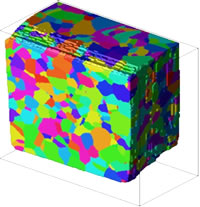 Most metallic and ceramic materials used in aircraft, automobiles, and devices such as computers are polycrystalline. In other words, they are made up of many microscopic crystals held together by grain boundaries. It is widely recognized that the types of grain boundaries in a material and the manner in which they are connected affect a wide range of properties and, ultimately, a material's performance and lifetime. In most cases, however, our ability to predict and control the materials properties that are governed by the grain boundaries is severely limited by our incomplete knowledge of the network structure and the behavior of individual interfaces. The CMU MRSEC's goals are to understand the origins of the quantifiable characteristics of polycrystals that arise during processing, to develop strategies for influencing these characteristics in predictable ways, and to define microstructural metrics that can be directly related to macroscopic properties and performance. The Center's tools and findings will have applications in a range of practical materials processing applications and, to insure rapid implementation, we work collaboratively with government, industry, and international laboratories.
CSPIN — Center for Semiconductor Physics in Nanostructures (2005)
The University of Oklahoma / University of Arkansas Materials Research Science and Engineering Center (MRSEC), titled the Center for Semiconductor Physics in Nanostructures (CSPIN), supports innovative research and education in controlled growth of semiconductor and ferroelectric arrays, and narrow band gap semiconductor heterostructures. Potential applications include inexpensive high density, low power, non-volatile memory, negative refractive index materials, and improved magnetic read-head technology. The center will develop coordinated activities in graduate and undergraduate education, advance inquiry based learning for the improved understanding of K-12 science, and partner with regional museums to produce exhibits for the general public.
The MRSEC consists of two Interdisciplinary Research Groups (IRGs); IRG-1 Collective Properties of Nanostructure Arrays - control over semiconductor and ferroelectric materials growth will yield systems that give new insight into the collective interactions between individual quantum dots, wires and rings, and will provide the basis for new optical and electronic materials. IRG-2 Mesoscopic Narrow Gap Systems - explores the unique properties of narrow bandgap semiconductor materials to address nanoscale electronic devices that exploit quantum mechanical effects for higher speed operation, denser memory with increased functionality.
The Bioinspired Soft Materials Center
The Brandeis Materials Research Science and Engineering Center (MRSEC) seeks to create new materials that are constructed from only a few simplified components, yet capture the remarkable functionalities found in living organisms.
UMD Materials Research Science and Engineering Center (2000)
The Materials Research Science and Engineering Center (MRSEC) at the University of Maryland addresses fundamental problems connected with the dynamics of ferroelectrics and of surface nanostructures, and with the properties of highly spin polarized magnetic oxides. The MRSEC supports an effective pre-college education outreach effort that includes summer science programs for middle school girls and hands-on math and science student programs. The Center has intensive activities for knowledge transfer to a large number of industrial and federal laboratories. The MRSEC also supports promising new projects through seed funding, and develops and maintains shared experimental facilities.
Research in the proposed Center is organized into three Interdisciplinary research Groups (IRG). IRG 1, Polarization Dynamics in Ferroelectric Thin Films, addresses key materials issues that will allow to control and optimize the time-dependent behavior of thin film ferroelectrics, and that currently limit their applicability to computer memories, sensors and actuators. IRG 2, Surface Nanostructures: From Fluctuations to Driven Systems, builds upon powerful experimental and theoretical tools developed by this group of investigators to predict the surface structural evolution of films under various processing conditions, including chemical vapor deposition growth and electromigration. IRG 3, Metal Oxides with High Spin Polarization, focuses on issues limiting development of metallic oxides with high spin polarization that can be utilized in magnetic devices, including 'spintronics' and magnetic sensors.
CRISP: Center for Research on Interface Structures and Phenomena (2011)
The Center for Research on Interface Structures and Phenomena (CRISP) discovers and develops novel atomically engineered materials and processes across a wide spectrum such as amorphous metals or artificially structured crystalline oxide interfaces. This research also serves as an effective vehicle for student recruitment, retention, and education in Science, Technology, Engineering, and Mathematics (STEM). CRISP includes two interdisciplinary research groups (IRGs): 1) the Atomic Scale Design, Control and Characterization of Oxide Structures IRG focuses on understanding and engineering the novel chemical, electronic, and magneto-electric phenomena that arise at atomically abrupt complex oxide interfaces; and 2) the Multi-Scale Surface Engineering with Metallic Glasses IRG addresses the grand challenge of how to control surface properties through topographical structuring at multiple length scales (examples include tailoring biocompatibility, reactivity, friction, adhesion, and wetting to efficiently functionalize surfaces for a wide range of new applications and devices). Each IRG relies on (i) unique, world-class expertise at Yale, Southern Connecticut State University (SCSU), and industrial, national laboratory, and international partners; (ii) demonstrated, seamless multi-disciplinary collaborations; and (iii) extensive shared facilities to address grand challenges in materials research through multi-faceted efforts that include physical and biological sciences, engineering, and interplay between state-of-the-art theory and experiment. The research is closely integrated with education and outreach (EO) efforts through partnerships among a major research university (Yale), the largest educator of teachers in the state (SCSU), and the economically distressed, under-represented minority (URM)-dominated New Haven Public School System (NHPS). These partnerships provide model programs for recruitment, retention, and broadened participation in STEM careers that may be replicated nationwide. Further, CRISP faculty members are committed to enhancing cultural, gender, ethnic and racial diversity among STEM students and faculty, and more broadly among science students, teachers, and researchers nationally.
For education and Human Resource Development, CRISP uses the interdisciplinary, innovative aspects of its research to enhance STEM recruitment, retention, education, and to broaden participation by under-represented groups. The focus is on two successful signature initiatives that are evolving based on continued quantitative outcome assessments. The Materials Research Center Initiative for STEM Education (MISE) enhances STEM recruitment and retention through professional development of teachers that enhances their teaching abilities. This efficiently impacts the largest number of students, resulting in a substantial multiplying effect. The Materials Research Center Initiative for Multidisciplinary Education and Research (MIMER) provides interdisciplinary team-based research and education opportunities to the entire spectrum of STEM professionals and students. Teams work on integrated IRG research projects that form bridges to multidisciplinary courses and training projects. The integration of these EO efforts with graduate research uniquely prepares CRISP participants to succeed in, and ultimately lead, multi-disciplinary, multi-cultural efforts that are increasingly important to solve complex, large- scale problems. CRISP also prepares postdoctoral researchers for independent research careers by giving them latitude in defining research thrusts while providing them professional development training ranging from proposal writing to research management.
CRISP partnerships with national laboratories, industry, educational institutions, and state and local government agencies help CRISP realize its research and human resource development visions while broadening its impact. Key in-depth collaborations continue to be developed with Brookhaven and Argonne National Laboratories (BNL and ANL) that enable joint development of new characterization methods. Industrial partners, such as IBM or the PX Group, provide CRISP with a pathway towards commercialization of basic research findings. CRISP’s interactions with international universities are highlighted by Joint Research Centers with Peking University on Microelectronics and Nanotechnology and with the Karlsruhe Institute of Technology on Advanced Atomic Force Microscopy Methods. Both endeavors involve joint projects and faculty and student exchanges, providing CRISP access to unique facilities at the partner institutions. CRISP’s partnership with the New Haven Public School System provides detailed teacher evaluation data for a predominantly minority- serving school system that enables CRISP to direct its professional development (PD) towards teachers with the greatest needs, providing them with individualized PD plans. CRISP also works with the Connecticut Office of Workforce Competitiveness to develop new EO programs that span K-12, community colleges, and PD.
MIT Center for Materials Science and Engineering (2014)
The MIT Center for Materials Science and Engineering (CMSE) is devoted to the design, creation, and fundamental understanding of materials that are capable of enhancing the human experience. CMSE has a special mission: to foster collaborative, interdisciplinary research and education in the science and engineering of materials that will address the future needs of society. CMSE promotes collaboration among MIT faculty and between MIT faculty and researchers of other universities, industry, and government laboratories.
Showing 901 to 910 of 2653