Reconfigurable Responses in Mixed-Dimensional Heterojunctions
This IRG explores how heterojunctions consisting of nanoelectronic materials of differing dimensionality are influenced by dielectric screening, electronic band/level offsets, and interfacial regions. By utilizing low-dimensional materials synthesis, surface chemical functionalization, spatially and spectrally resolved characterization, and advanced computation, IRG-1 develops quantitative descriptions of the nonlinear responses in mixed-dimensional heterojunctions. Elucidation of the mechanisms governing structural changes, and the corresponding changes in optoelectronic properties, allows controllable reconfiguration in response to stimuli including electric fields, photons, heating, and reactive species with implications for neuromorphic computing.
Novel Processing Methods for Nanostructured Polymer Blends, Composites and Supramolecular Structures
The primary goal of IRG #2 is to develop and produce materials with superior mechanical properties using polymer-based processing strategies that include polymers, ceramics, metals, and structured composite materials. Polymers and gels are versatile materials with useful mechanical, electrical and biological functions. Center scientists are developing methods for controlling the properties of these materials by tuning the structure at the molecular level, by developing supramolecular assemblies with dimensions in the nanometer range, and by the addition of appropriately chosen nanoparticle fillers.?е║ Approaches to self assembly include the use of hydrophobic and hydrogen bonding interactions in low molecular weight peptide amphiphiles, and control of the sequence distribution in 'gradient copolymers', which can be made to exhibit a well-defined composition gradient along the polymer backbone.?е║?е║ Equilibrium and non-equilibrium approaches are being developed for the dispersion of nanoparticles, including single-walled carbon nanotubes and graphene nanoplatelets, and design principles for obtaining assemblies with the desired structure and properties are being investigated.
Multi-scale Surface Engineering with Metallic Glasses
The new Multi-scale Surface Engineering with Metallic Glasses IRG addresses the grand challenge of how to control surface properties through topographical structuring at multiple length scales. Examples include tailoring biocompatibility, reactivity, friction, adhesion, and wetting to efficiently functionalize surfaces for a wide range of new applications and devices. To this end, nano-imprinting and blow molding, whose application to metallic glasses has been pioneered at Yale, are utilized to create hierarchically structured metal surfaces on length scales ranging from atomic distances to ≈10 μm. The IRG’s intellectual merit is rooted in gaining a fundamental understanding of the deformation of metallic glasses on these length scales and on using this knowledge to create hierarchical surface patterns, often inspired by nature, to achieve and exploit unusual surface properties. The broader impacts of the research will be felt in novel devices, in the understanding and utilization of size-dependent properties, in pushing the limit in imprinting density beyond current constraints, and in efficient and versatile processes to functionalize metallic surfaces. This research program provides undergraduates, graduate students, postdoctoral fellows, and teachers with unique training that allows them to understand complex phenomena on scales ranging from atoms to cm.
Magnetic Heterostructures
 Magnetic Heterostructures uses advanced materials synthesis, novel measurement techniques and innovative theoretical approaches to explore spin transport across interfaces and in confined geometries. A particular focus of this work is the physics and materials science of transport and dynamics in hybrid systems in which ferromagnets are integrated with other materials, including semiconductors and normal metals. This research will impact upon the development of new magnetic sensors as well as non-volatile memory and magnetic storage media.
Center for Photonic and Multiscale Nanomaterials (2011)
The Center for Photonic and Multiscale Nanomaterials (C-PHOM) is a National Science Foundation Materials Research Science and Engineering Center, established in 2011. The center’s research activity is focused on two Interdisciplinary Research Groups (IRG’s): wide-bandgap nanostructured materials for quantum light emitters and advanced electromagnetic metamaterials and near-field tools. The center is housed primarily at the University of Michigan; the Metamaterials IRG is a partnership between the University of Michigan and Purdue University. Other participating institutions include the University of Texas at Austin, University of Illinois Urbana Champaign, Wayne State University, and the City College of New York.
Nonlinear Interactions Between Spin Flux and Engineered Magnetic Textures
Study of spin transport has seen an explosion of interest and growth reflecting the richness of the underlying physics and the potential for technological application. IRG-3 is exploring a new frontier in spin transport by moving beyond the regime of diffusive transport. Nonlinear magnetic dynamics will arise from non-adiabatic torques in sharp textures, collective transport in dynamic textures, and large spin fluxes. IRG-3 combines theory, modeling and ab-initio materials prediction with expertise in spin-thermal transport, diverse magnetic and semiconductor materials growth, and high sensitivity spin detection to provide foundations for new approaches to manipulation and control of spin transport.
IRG-3 Faculty
- Joseph Heremans, Professor of Mechanical & Aerospace Engr. (Co-leader)
- Fengyuan Yang, Assoc. Professor of Physics (Co-leader)
- Ezekiel Johnston-Halperin, Assoc. Professor of Physics
- P. Chris Hammel, Professor of Physics
- Roberto Myers, Assoc. Professor of Materials Science Engineering
- Wolfgang Windl, Professor of Materials Science Engineering
- Michael Flatte, Professor of Physics, University of Iowa
- Yaroslav Tserkovnyak, Professor of Physics, UCLA
Organic Optoelectronic Interfaces
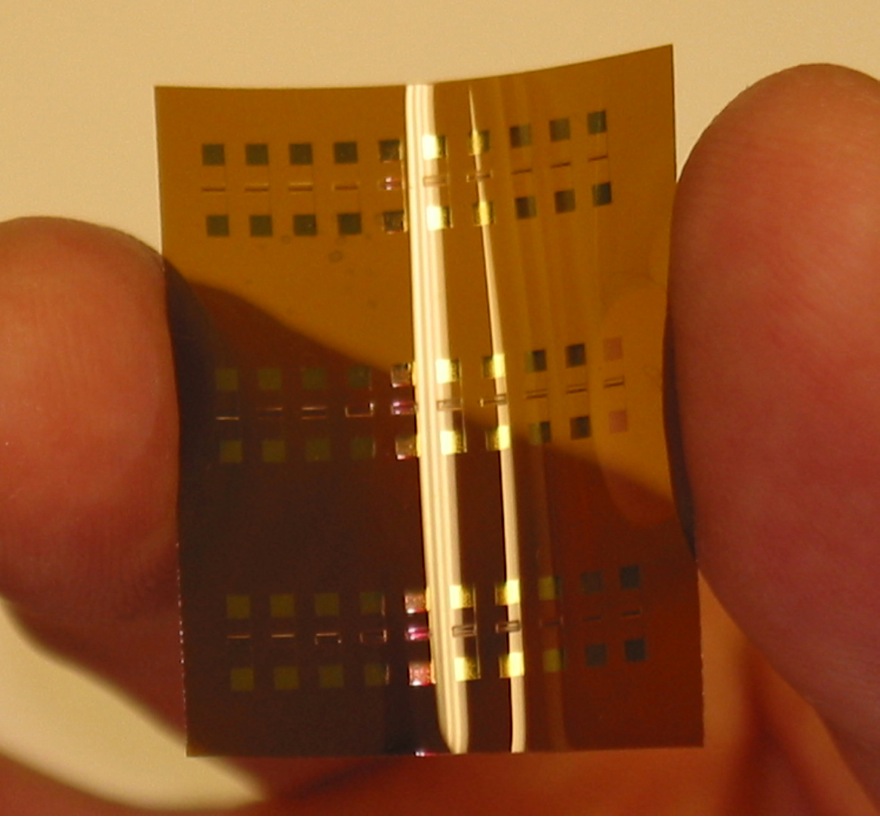
Organic Optoelectronic Interfaces relies on a combination of experimental and theoretical approaches to determine the key structure-property relationships associated with interfaces in a new generation of organic optoelectronic devices. By combining its expertise in molecular synthesis, film growth, transport, spectroscopy, computation, and modeling, the IRG aims to fabricate and characterize organic-insulator, organic-organic, and organic-metal interfaces with enhanced performance in field effect transistors (OFETs) and photovoltaic cells (OPVs).
Random Organization of Disordered Materials
IRG 1: Random Organization of Disordered Materials combines researchers from Chemistry, Civil and Chemical Engineering, Mathematics and Physics to investigate new principles for organizing and controlling the microstructure of multiscale materials. The IRG builds on the remarkable discovery of the Random Organization Principle, pioneered by NYU MRSEC investigators, by which systems driven out of equilibrium evolve towards absorbing states in which dynamic rearrangement ceases. IRG 1 explores the structures and correlations that arise in granular, multicomponent and active materials under external and internal driving, particularly those of the absorbing states, seeking to optimize material properties such as yield strength and photonic band structure, and to develop active materials such as optically
reconfigurable colloids and active extensile viscoelastic liquids.
Faculty and Senior Participants: Jasna Brujic, Paul M. Chaikin, Aleks Donev, Alexander Grosberg, Magued Iskander, David J. Pine, Stefano Secanna, Nadrian C. Seeman, Mike J. Shelley, Eric Vanden-Eijnden
Functional Cylindrical Assemblies
 Senior Investigators: Dennis E. Discher & Andrea Liu
IRG Leaders; Paul A. Heiney, Randall D. Kamien, Michael L. Klein, Virgil Percec, Shu Yang
IRG-2 will collaborate to synthesize sstrongi-flexible, functional cylinders composed of dendrimer-based polymers & self-assstrongbling block copolymers. The goal is to understand the interplay between soft structure & function and thereby develop cylinders whose meso-conformations can be controlled to generate mechanical motion and cylinders that can be arrayed as flow-responsive nano-reactors.
Senior Investigators: Dennis E. Discher & Andrea Liu
IRG Leaders; Paul A. Heiney, Randall D. Kamien, Michael L. Klein, Virgil Percec, Shu Yang
IRG-2 will collaborate to synthesize sstrongi-flexible, functional cylinders composed of dendrimer-based polymers & self-assstrongbling block copolymers. The goal is to understand the interplay between soft structure & function and thereby develop cylinders whose meso-conformations can be controlled to generate mechanical motion and cylinders that can be arrayed as flow-responsive nano-reactors.
Designing Functionality into Layered Ferroics
IRG1, Designing Functionality into Layered Ferroics, will showcase materials discovery by design for electric field control of electronic, optical, magnetic and structural response of materials starting from the level of atoms. The goal is to design and discover fundamental new mechanisms and material classes of acentric layered oxides with strong coupling to spin, charge, and lattice degrees of freedom. An unprecedented expansion of ferroic families in layered oxides – a vast and largely unexplored materials class with unique control knobs in chemistry, topology, and geometry – will enable the design of ferro- & ferri-electricity, magnetoelectricity, multiferroicity, and gradient-driven effects. We will counterpoise competing phases with colossal properties to transform otherwise nonpolar materials into strongly polar ones and will couple electrical, magnetic and structural order parameters. Group theory, materials informatics, first-principles DFT, model Hamiltonians, and phase-field modeling will predict new ferroic systems and guide experimental efforts. Potential new technologies include room temperature electric field control of ferromagnetism, highly nonlinear optical materials, high temperature piezoelectrics, GHz electronics, and electric field control of correlated phenomena.
Showing 971 to 980 of 2653