Center for Materials for Information Technology (1994)
The Materials Research Science and Engineering Center (MRSEC) at the University of Alabama features a multidisciplinary research program built on a solid foundation provided by the existing Center for Materials for Information Technology (MINT). The MRSEC supports interactive research through two interdisciplinary research groups. The group which focuses on the relationship of microstructure and magnetic properties carries out fundamental measurements on materials systems which have potential applications in future magnetic recording systems. Of particular interest are nitrogenated iron based alloys, high magnetization iron nitride films and giant magnetoresistance thin films. The group which concentrates on the preparation and dispersion of magnetic nanoparticles is directed to develop new synthetic methods for the preparation of magnetic particles and to gain a fundamental understanding of magnetic dispersions. The MRSEC is housed in the same research building where the MINT Center is located and shares a number of central facilities with the existing center. Collaboration with industry is extensive and well established by the MINT Center. The MRSEC provides seed funding for exploratory research and emphasizes minority recruitment and interdisciplinary training. A major component of the educational goals is to attract, retain and train more students in a technologically important area where, as demonstrated by the success of graduates, excellent jobs are available. The close association with the Historically Back Colleges and Universities (HBCU) in the South is utilized to enhance current outreach programs that support minority students and faculty. The center currently supports 7 faculty, 5 post-doctoral assistants, and 5 graduate students. The MRSEC is directed by Professor William Doyle.
Advanced metamaterials and near-field tools
Mission:
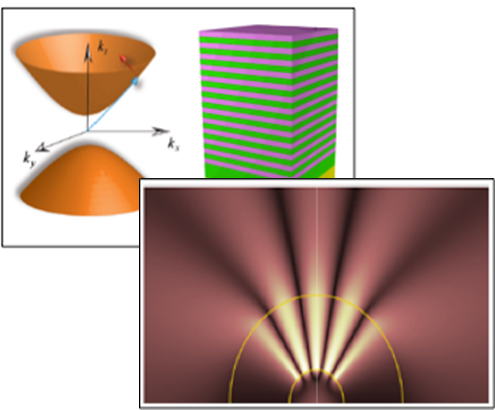
This IRG will investigate metamaterials- particularly chiral, quasiperiodic and hyperbolic MMs – and MM-inspired structures with unusual properties such as near-field plates and hyperlenses, and develop understanding applicable to communication, sensing and imaging.
Research Overview:
Metamaterials (MMs) are homogeneous artificial mixtures, that is, composites for which the distance be-tween neighboring inclusions is significantly smaller than the wavelength of interest. Recent advances in assembly methods, micro- and nanofabrication, coupled with an increased understanding of their electro-magnetic (EM) response have led to the synthesis of composites whose behavior is quite unlike those of natural materials. Negative refraction, cloaking, plasmonic hot-spots, super-resolution, and high-frequency magnetism are but a few of the terms that were introduced into the scientific vocabulary during the past decade following continuous progress in MMs research. This IRG program provides a comprehensive approach for the development of novel composites; particularly chiral, quasiperiodic and hyperbolic MMs; and MMs-inspired struct
ures with unusual physical properties, such as near-field (NF) plates and hyperlenses. The research combines state-of-the-art self-organized, epitaxial growth and lithographic techniques with the development of innovative NF experimental tools, together with a strong theoretical basis and a multiplicity of characterization methods.
An example of the way recent breakthroughs in metamaterialsresearch has opened up new frontiers in photonics is the recent demoonstration by Shalaev and coworkers at Purdue that the high losses normally present in plasmonic MMs can be overcome by incorporating gain media within the composite. In another example, at the University of Michigan, Merlin and colleagues have devised novel structures such as near-field plates for superresolution imaging. Based on these and related breakthroughs, IRG2 explores this newly opened frontier of MMs as a partnership between Michigan and Purdue, with additional collaborations from the University of Texas and Wayne State University.
Powered Motion at the Nanoscale
IRG2 makes, models, and studies autonomous motors and pumps that convert the free energy of local chemical, optical, thermal, and acoustic fields to motion. In addition to providing information about the mechanisms of motility, the study of synthetic motors helps address fundamental questions about emergent collective behavior at low Reynolds number and on length scales from sub-nanometers to hundreds of micrometers. Much of our understanding of active matter derives from continuum theories coupled to observations of complex biological swimmers or externally driven colloidal particles. The observation in abiotic systems of many behaviors previously associated with purely biological processes suggest intriguing questions as to the underlying principles that govern both. The IRG2 team pursues a bottom-up approach to understanding motility, sensing and emergent collective behavior in autonomously driven synthetic systems by combining theory and numerical modeling with the synthesis and experimental study of new classes of motors.
Important findings in IRG2 include the discovery of synthetic autonomous nanomotors and micropumps driven by catalysis and light, elucidation of their self-electrophoretic propulsion mechanisms, discovery of complex swarming, predator-prey, and spatio-temporal oscillatory behavior in colloidal motor assemblies, engineering of chemotaxis, steering, and cargo delivery in motor systems, demonstration of catalytically powered motion at the nm scale of individual catalyst molecules, including (non-motor) enzyme molecules, characterization of momentum transfer by active swimmers at length scales from colloidal to molecular, and discovery of two new acoustic motor propulsion mechanisms that are tolerant of electrolyte solutions and gel media, including the interior of living cells.
Materials for Next Generation Photovoltaics
The vision of this IRG is to drive, “Transformational improvement in solar energy conversion through fundamental materials innovation.” There are two aspects to its strategy for realizing this vision. The first involves its core research mission directed at “Understanding, controlling and exploiting the unique properties of group IV nanostructures in photovoltaic architectures.” The second is to be an enabler acting as a “nucleation and growth point for a broad range of materials research in solar energy conversion.” The research program is directed at creating technology discontinuities that significantly shorten the time scale for solar energy to make a major contribution to world energy production. Critical to success is the Center’s integration of unique nano materials synthesis, novel characterization and computational interrogation.
Electrostatic Control of Materials
The vision of IRG-1, Electrostatic Control of Materials, is to use a set of new techniques for electrostatic manipulation of charge carrier density at material surfaces as a universal platform to probe and control electronic properties in novel materials. Recently developed methods based on ionic liquids, ionic gels, and solid electrolyte structures are being used to generate unprecedented charge densities in a variety of materials, up to significant fractions of an electron per unit cell, enabling dramatic property modification. Opportunities include reversible control of magnetic order and properties, fine-tuning of insulator-metal and superconducting transitions, novel electronic and opto-electronic device concepts, discovery of new electronic and magnetic phases, and determination of the limits of transport in new materials. The IRG is exploring three classes of materials of exceptional current interest as test cases: (i) organic conductors; (ii) metal chalcogenides; and (iii) complex oxides.

Molecular Crystal Growth Mechanism
IRG 2: Molecular Crystal Growth Mechanisms assembles a team from Chemical Engineering, Chemistry, Mathematics, and Physics to investigate the fundamental science of molecular crystal growth, an area of vital interest for pharmaceuticals, organic electronics, and other technologies. While crystal growth of metals, semiconductors, and binary oxides is highly developed, understanding of basic elements of molecular crystal growth is lacking. The IRG advances the understanding of essential aspects of crystal growth science and engineering, investigating nucleation, dislocation generation and structure, multi-step assembly at the unit cell level, and origins of non-classical morphologies in molecular crystals. IRG 2 combines theoretical modeling, computer simulation, and experiment to develop predictive models of crystal structure and free energy and to investigate the dynamic aspects of crystal growth.
Senior Participants: Daniella Buccella, Bruce. Garetz, David G. Grier, Maranda Holmes-Cerfon, B. Kahr, Robert Kohn, Jin Montclare, Mark Tuckerman, Michael D. Ward, Marcus Weck.
Organic Spintronics
Mission
- Answer fundamental questions about the basic properties of spin excitations in organic semiconductors (OSEC).
- Apply this knowledge toward development and fabrication of spin-related OSEC devices.
Why Organic Spintronics?
- Rich physics from the precursor polaron-pair state: spin-mediated organic electronics.
- Rich chemistry: OSEC are lightweight, environmentally friendly, inexpensive, and very versatile.
- Engineering and commercializationpotential: several existing companies focus on organic optoelectronics.
Questions
The goal of IRG-2 in Organic Spintronics is to provide insight to the following questions:
- Can we control the ratio between spin triplet and singlet excitations in OSEC and organic devices?
- Can we control and manipulate the interaction between spin-aligned carriers and nuclear spin polarization?
- Can organic-ferromagnet electrodes serve as spin injectors into OSEC?
- What are the temperature limitations of organic spintronics?
- Can we control the spin-injected current by an external electric field?
- Is there a Hanle effect in organic spin valves?
- How do we make devices stable?
Potential Applications
- Organic spin-valves → inexpensive mass-producible magnetic sensors (data storage).
- Spin-organic LED with color tuned by magnetic field → displays.
- Organic optoelectronic devices → environmental sensors (e.g., electronic properties change as a function of imbibed gas).
- Organic photovoltaics → more efficient, inexpensive, and robust solar cells.
Center for Materials for Information Technology (1998)
The Materials Research Science and Engineering Center (MRSEC) at the University of Alabama carries out a vigorous program on materials with potential applications in ultra-high density data storage. Two interdisciplinary groups investigate thin films and particulate materials, respectively. Of particular interest in thin films are fundamental studies of magnetotransport, nanoscale surface studies, the investigation of high speed magnetic switching phenomena, as well as nanoscale tribological studies. In the area of particulate materials the focus is on potential applications in flexible (tape and floppy disk) storage media. Investigations include the synthesis of small, orientable magnetic nanoparticles, and the characterization and simulation of the microstructure of magnetic particle dispersions. The Center has an educational outreach program to high school science teachers and has very strong links with the information storage industry.
New Semiconductors for Solar Fuel Synthesis (Seed 4)
Principal Investigators
Robert J. Cava (Chemistry)
Andrew B. Bocarsly (Chemistry)
* This seed is inactive.
No artificial photosynthesis process has yet been industrialized to economically produce chemical fuels from renewable feedstock. Our long‐term goal for this project is to find new semiconductor‐photocatalysts to increase the diversity and efficiency of energy converting materials while addressing the issue of the excess greenhouse gas CO2 in the atmosphere. One PI has extensive knowledge in solid‐state materials design, while the other is an expert in photoelectrochemistry. Specific goals of this project are: 1) To look for new semiconductor photocatalysts with robust corrosion resistance and suitable band‐gaps for water photolysis or CO2 reduction catalysis under visible light irradiation, with a focus on bandgap engineering through systematic doping and nitriding/sulfiding; 2) to develop synthetic methods that optimize photocatalysts’ efficiency in water photolysis and CO2 reduction and study their structural/physical‐photocatalytic property relationships; 3) to establish a straightforward electrochemical methodology to screen potential semiconductor‐photocatalysts by using a custom‐built photoelectrochemical cell that directly compares samples’ current density under dark and illuminated conditions and performs bulk electrolysis analysis.
Biological Active Materials
The laws of equilibrium statistical mechanics impose severe constraints on the properties of conventional materials assembled from inanimate building blocks. Consequently, such materials cannot exhibit spontaneous motion or perform macroscopic work. Inspired by biological phenomena such as ciliary beating, Drosophila cytoplasmic streaming and actin treadmilling, this IRG will develop an entirely new category of materials assembled from animate, energy-consuming building blocks. Released from the constraints of equilibrium, such materials will acquire new functionalities. For example, in contrast to conventional gels, which remain quiescent unless driven by external forces, the spontaneous internal flows of active gels exert macroscopic force on the boundaries of a rheometer. Such force-producing active fluids are just one example of highly-sought biomimetic functionalities that are found in internally driven active materials. Fully functional biological structures are fragile and difficult to control and are thus poorly suited for materials science applications. To overcome this limitation, we will develop tunable and robust biomimetic systems from a few well-characterized building blocks. These systems will serve as an ideal platform for developing novel material applications, testing fundamental models of far-from-equilibrium active matter, and potentially shedding light on self-organization in living cells. Ultimately, our work will bridge the chasm between the remarkable properties of animate biological organelles or cells and traditional materials science, which has focused on building inanimate structures.
Showing 981 to 990 of 2653